




Are Elastic Laces Better Than Lock Laces? A 2026 Comparison
Table of Contents
- Elastic Laces vs Lock Laces: How the Two Systems Compare
- uLace vs Lock Laces: A Side-by-Side Comparison
- Benefits of Elastic Shoelaces for Runners
- Best No-Tie Lacing Systems for Sports Shoes
- Tension Control, Locking Mechanisms, and Secure Fit
- Durability, Maintenance, and Long-Term Foot Health
- Which Lacing System Is Right for You?
- Frequently Asked Questions
Last Updated: September 26, 2026
Elastic Laces vs Lock Laces: How the Two Systems Compare
Elastic laces are stretchable, no-tie laces that hold shoes on through constant gentle tension, while lock laces use a thin cord pulled tight through a plastic toggle. That design difference decides how they feel, how they wear, and who they suit. This comparison from uLace breaks down where each system wins.
The Core Difference: One-Piece Elastic vs Toggle-and-Cord
The core difference is how each system holds tension. One-piece elastic laces stretch across the whole foot and distribute pressure evenly; toggle-and-cord systems lock a single point of tension at the top of the shoe.
Neither approach is wrong. They simply solve different problems:
- Elastic laces prioritize even pressure, foot swelling accommodation, and slip-in convenience
- Lock laces prioritize a locked, adjustable fit you can re-tighten in seconds
- Elastic laces suit shoes you wear all day
- Lock laces suit shoes you tighten for a specific activity
uLace vs Lock Laces: A Side-by-Side Comparison
uLace wins on all-day comfort and even pressure distribution; lock lace systems win on instant re-tightening for short bursts of activity. For most people wearing sneakers through a normal day, elastic laces are the better fit.
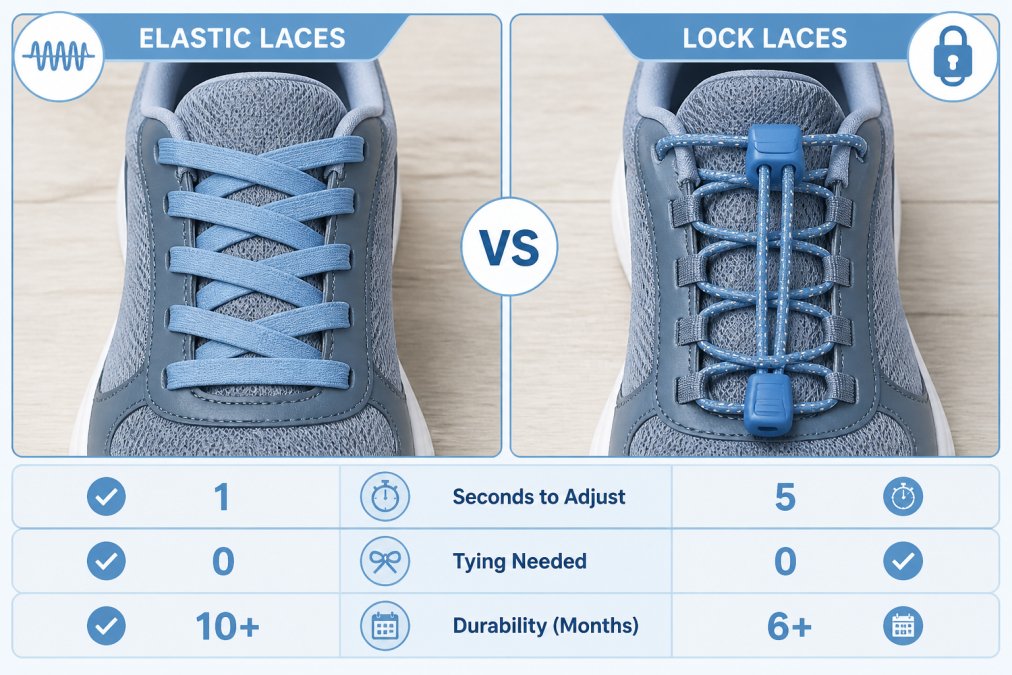
| Factor | Elastic Laces (uLace) | Lock Laces |
|---|---|---|
| How it holds | Even stretch across all eyelets | Single toggle point at the top |
| Tension adjustment | Customizable by threading pattern | Quick-release toggle |
| Installation | Push and pull, no tools | Thread cord, cut, fit toggle |
| Best for | All-day wear, kids, seniors | Quick re-tightening during activity |
| Feel | Soft, forgiving, slip-on | Firm, locked, sporty |
| Price | From $6.49 | Varies by brand |
Benefits of Elastic Shoelaces for Runners
Elastic shoelaces give runners consistent foot compression without hot spots and eliminate the mid-run stop to re-tie. For racing flats and triathlon transition, that speed matters.
The benefits stack up quickly:
- No re-tightening mid-run. The lace holds its tension through the whole stride cycle.
- Faster transitions. Slip the shoe on and go, which is why triathlon athletes favor elastic systems.
- Better foot swelling accommodation. Feet expand during long efforts; elastic gives with them.
- Fewer distractions. Nothing dangles, nothing comes untied.
Best No-Tie Lacing Systems for Sports Shoes
For sports shoes, look for these traits:
- Durable elastic that springs back instead of stretching out
- Flat profile that will not dig into the tongue
- Secure fit across the midfoot, not just the top
- Hardware durability if the system uses any hardware at all
Coming from standard laces, expect the first wear to feel looser than usual. That is the elastic working, not a fitting problem.
Tension Control, Locking Mechanisms, and Secure Fit
Tension control is where these systems diverge most: elastic laces adjust through your threading pattern; lock laces through a toggle that clamps the cord.
How Each Locking Mechanism Actually Works
Elastic laces have no hardware. Tension is set once by how tightly you weave the lace through the eyelets and how many cross-overs you use; the elastic then holds that setting, giving slightly with each step and pulling back. Add a cross-over for a firmer midfoot, or skip one for a looser feel.
That difference produces different pressure profiles:
- Elastic: pressure spreads across the whole lacing area, which eases lace pressure on the top of the foot.
- Toggle: pressure concentrates where the cord crosses the instep, because the cord does not stretch to redistribute load.
Where Toggles Fail and Where Elastic Wins
Toggle systems have three predictable weak points:
- The spring. Dirt and grit work into the barrel and the spring loses its bite, so the toggle stops holding tension. Rinsing the toggle and working the button a few times restores it temporarily.
- The jaw. Repeated clamping wears a groove in the cord at the same spot, and that is where the cord eventually breaks.
- The button. Cold weather makes plastic brittle, and a drop onto a hard surface can crack the housing.
Elastic laces have none of these parts. The trade-off is that you cannot micro-adjust tension on the fly. You change fit by re-threading, not by squeezing a toggle.
Accessibility and Hand Strength
For anyone with arthritis, carpal tunnel, or limited grip strength, the toggle can be hard to press: the spring resistance that keeps it from slipping is the same resistance that makes it difficult to operate. Elastic laces need no squeezing, which is why they are commonly recommended as an accessibility aid for people who cannot bend to tie or lack the fine motor control for a toggle.
Matching the System to the Activity
- All-day wear and walking: elastic. Even pressure and no hardware to press.
- Short bursts of activity with fit changes: a toggle is convenient because you can loosen and re-tighten in seconds.
- Racing and transition sports: elastic, because there is nothing to press and nothing to snag.
- Court sports with rapid lateral cuts: either can work, but check that the midfoot stays locked. If the foot slides side to side, the lace is too loose at the midfoot regardless of system.
A quick test for secure fit: lace up, then try to slide your heel up and down inside the shoe. If it moves more than a few millimeters, tighten the midfoot cross-over before touching the top eyelets.
Durability, Maintenance, and Long-Term Foot Health
Elastic laces generally outlast thin cord-and-toggle systems in daily wear: there is no plastic toggle to crack and no single cord to fray at one stress point. A well-made flat elastic holds its stretch for the life of the shoe; a thin round cord tends to fail first at the toggle jaws or where it exits the top eyelet.
- Flat woven elastic (polyester or nylon wrapped around rubber core). Lies flat against the tongue, spreads pressure, and recovers well. Best all-around choice for daily sneakers.
- Round bungee cord (often nylon sheath over rubber). Stretches more, feels springier, but concentrates pressure in a narrow band and frays faster where it rubs the eyelet.
- Silicone or TPE laces. Do not absorb water, wipe clean easily, and resist odor, but they have less stretch recovery and can feel stiff in cold weather.
Maintenance habits that extend life:
- Hand-wash elastic laces in cool water with a drop of mild detergent, then air-dry. Heat from a dryer breaks down the elastic core over time.
- On cord-and-toggle systems, inspect the toggle for hairline cracks, which is the most common failure point, and check the cord where it passes through the top eyelet.
- Replace laces as soon as they stop springing back, since a stretched-out elastic no longer distributes load.
- Rotate between pairs if you wear the same shoes daily, which lets each lace recover between wears.
- Keep laces away from direct sun and car dashboards; UV and heat degrade synthetic elastic faster than normal wear.
The Long-Term Foot Health Angle Most Comparisons Skip
Two mechanisms matter most:
- Circulation restriction. A thin cord pulled tight through a toggle concentrates force across a narrow band on the instep. Over a long day, that band can restrict blood flow and compress the dorsal nerves, producing numbness or a tingling sensation across the top of the foot. A flat elastic spreads the same tension over a wider area, which is why it tends to feel less pinching after several hours.
- Arch support and foot position. Laces do not create arch support on their own, but they do influence how the midfoot sits in the shoe. A lace that holds the midfoot evenly lets the foot's natural arch mechanism work; a lace that is too loose at the midfoot lets the foot slide forward and forces the toes to grip, which contributes to fatigue and, over time, to hammer-toe and plantar pressure patterns.
If you have diabetes, peripheral neuropathy, or a history of foot ulcers, lace pressure is worth discussing with a podiatrist before switching systems. The general principle of avoiding concentrated pressure points applies to any footwear choice, but the stakes are higher when sensation is reduced.
Which Lacing System Is Right for You?
Choose elastic laces for all-day comfort, easy slip-on convenience, and even pressure. Choose lock laces for a toggle you can re-tighten in a second during short bursts of activity.
Here is a quick way to decide:
- Kids and morning routines: elastic laces. No tying, no loose ends, no lost time.
- Seniors and anyone with limited mobility: elastic laces. No bending, no squeezing a toggle.
- Runners and triathletes: elastic laces for transition speed and long-distance comfort.
- Court sports with rapid fit changes: a toggle system can be handy, though elastic handles most sports fine.
- Everyday sneakers: elastic laces keep shoes looking neat and tidy with no dangling strings.
Frequently Asked Questions
Do elastic shoelaces really work?
Elastic laces work by replacing the knot with stretch. A one-piece elastic system like uLace threads through your existing eyelets and holds the shoe with tension rather than a tie. The stretch lets the shoe open wide enough to slip on, then contract around the foot. For everyday walking, school pickups, and errands, they keep shoes secure all day. For high-intensity running, the answer depends on the system: a flat elastic lace with even tension across the whole shoe tends to hold better than a thin cord with a single toggle point.
What is the main difference between elastic laces and lock laces?
Elastic laces are a single stretchy lace that runs through every eyelet, so tension is spread across the entire shoe. Lock laces use a thin elastic cord paired with a plastic toggle that slides and locks in one spot. That means lock laces adjust faster, but the pressure sits at the top of the foot rather than distributing evenly. Elastic laces take a bit more setup but hold a more consistent fit across the whole shoe.
Do lock laces provide better tension control than standard elastic laces?
Lock laces give you one adjustment point, the toggle, so you can tighten or loosen in a single motion. That is convenient for quick changes. Elastic laces give you tension adjustment across the whole lacing pattern, so you can leave the lower shoe snug and the upper shoe looser, or the reverse. If you want a single quick pull, a toggle wins. If you want the pressure spread evenly and a fit that does not need re-tightening mid-day, elastic laces are the better choice.
Are no-tie laces suitable for all types of athletic shoes?
Most athletic shoes with standard eyelets work with no-tie laces, including running shoes, trainers, and casual sneakers. The main limit is eyelet type: shoes with very small or oddly shaped eyelets may need a thinner lace. uLace Classic fits most classic sneakers, while uLace ProFormance is built for performance shoes. If your shoe has a strap closure, a zipper, or a slip-on design already, no-tie laces add little. Check your eyelet count and shoe width before ordering.
Are no-tie laces recommended for seniors or those with limited mobility?
Yes. Seniors and people with arthritis or limited hand strength are among the most common users of no-tie laces, because they remove the need to bend over and tie. uLace Classic starts at $6.49 and installs with a simple push-and-pull method. One uLace customer, age 72, said bending to tie laces had become difficult and now they just slip their foot in. The stretch also helps if feet swell during the day, since the lace gives instead of pressing.
The real challenge is not choosing between two lace types; it is finding a system that fits the shoes you already own and the life you actually live. uLace has been making no-tie elastic shoelaces since 2009, with a simple push-and-pull install, a range of styles and colors, and fast shipping. Whether you need all-day comfort for a parent, a senior, or a runner, the uLace line covers it. Take the quiz and find the right pair for your sneakers.