




Best Elastic Shoelaces for Kids: 2026 Guide
Table of Contents
- Why Elastic Shoelaces for Kids Actually Work
- No-Tie Shoelaces for Toddlers vs. Older Kids
- Flat vs Round Elastic Laces: Which Is Better for Kids?
- uLace Kiddos: Color Options and Style Comparison
- How to Install Elastic Laces on Kids' Sneakers
- Durability, Material Quality, and Adaptive Needs
- Choosing the Best Elastic Shoelaces for Kids: Quick Decision Guide
- Conclusion
Last Updated: August 21, 2026
Parents searching for the best elastic shoelaces for kids know the morning struggle: the bus is outside, your kid's shoes are untied, and nobody has time for a knot. uLace has been solving exactly this problem since 2009, and this guide breaks down everything you need to choose the right elastic laces for your child's shoes, feet, and daily routine.
Below, we cover the real developmental trade-offs of no-tie laces, how to match lace type to shoe style, a step-by-step installation guide, and a full color comparison of the uLace Kiddos line.
Quick Picks:
- Best Overall for Kids: uLace Kiddos (Rainbow or Shocking Pink) - fun, secure, and easy for any sneaker
- Best for Adaptive/Sensory Needs: uLace Kiddos - Medium Grey - neutral tone, consistent tension
- Best for School Uniforms: uLace Kiddos - White or Black - clean look, no fuss
Why Elastic Shoelaces for Kids Actually Work
Elastic shoelaces replace the need for a tied knot with consistent, distributed tension across every eyelet. Instead of one central knot holding the shoe closed, the stretch runs through the entire lacing system, creating a snug fit that adjusts with foot movement throughout the day.

A child who could never manage a double-knot can now put on and take off their own shoes independently.
Playground Safety and Knot-Free Convenience
Dangling laces create a specific playground hazard: a lace stepped on mid-run causes tripping. According to American Academy of Pediatrics safety guidelines, tripping is among the most frequent causes of playground injuries in children under 10. Knot-free laces remove that risk entirely.
No-tie elastic laces also eliminate the "forced entry" problem. Many kids shove their feet into sneakers without untying them, crushing the heel counter and damaging the shoe's structure. With elastic laces, the shoe opens enough to slip on cleanly every time.
Kids in after-school programs, gym class, or sports practice change shoes multiple times a day. Elastic laces turn a two-minute process into a ten-second one.
The Fine Motor Skills Trade-Off Parents Should Know
No-tie laces do reduce daily practice with tying. Fine motor skill development, including the pinching, looping, and crossing motions involved in shoelace tying, is valuable for children's hand coordination. Research from American Occupational Therapy Association resources on fine motor development highlights lace-tying as a benchmark skill for children around ages 5-7.
That doesn't mean elastic laces are the wrong call. They work best as a situational tool: for school days, sports, and hectic mornings. For kids actively learning to tie, keep a pair of traditionally laced shoes in the rotation for practice sessions.
No-Tie Shoelaces for Toddlers vs. Older Kids
No-tie shoelaces serve different purposes depending on shoe size and eyelet count.
Toddler shoes (roughly sizes 4-9 toddler) typically have fewer eyelets and simpler construction. Many are already slip-ons or use velcro, so elastic laces are less commonly needed. Where they do apply, the lacing must create enough tension to hold a small foot without cutting off circulation.
Older kids (sizes 1 and up in youth) wear sneakers that resemble adult athletic shoes, with 5-7 eyelet pairs and a proper heel cup. This is where elastic laces genuinely shine. The uLace Kiddos line is sized specifically for this range, providing the right tension and stretch for youth sneakers.
Sizing and Eyelet Compatibility by Shoe Type
Eyelet compatibility determines whether an elastic lace system works with a specific shoe.
| Shoe Type | Eyelet Count | Elastic Lace Fit | Notes |
|---|---|---|---|
| Youth athletic sneakers | 5-7 pairs | Excellent | Ideal for uLace Kiddos |
| Canvas low-tops | 4-5 pairs | Good | Slightly less tension at ankle |
| Running shoes (youth) | 6-8 pairs | Excellent | Check eyelet diameter |
| Dress shoes / leather | 3-4 pairs | Limited | Eyelets often too small |
| Hiking boots | 8+ pairs | Not recommended | Too many eyelets, insufficient stretch |
| Velcro toddler shoes | N/A | Not applicable | No eyelets to thread |
The uLace Kiddos laces use a push-and-pull anchor system that fits standard round eyelets found on most youth sneakers. If your child's shoes have very narrow or reinforced metal eyelets, measure the eyelet diameter before ordering.
Flat vs Round Elastic Laces: Which Is Better for Kids?
Flat elastic laces sit flush against the shoe's tongue and eyelet rows, creating a clean, low-profile look. They distribute pressure across a wider surface area, which many kids find more comfortable. Flat laces also stay in place better during active movement.
Round elastic laces have a more traditional shoelace appearance and work well in shoes with narrower eyelets where a flat lace might bunch. They're slightly easier to thread through tight eyelets but can create more localized pressure on the foot during extended wear. buying shoes online.
For most kids' sneakers, flat elastic laces are the better choice. The pressure distribution is more even, the look is neater, and they're less likely to twist inside the eyelet over time. The uLace Kiddos line uses a flat lace construction, which maintains a tidy appearance through repeated slip-on and slip-off use.
uLace Kiddos: Color Options and Style Comparison
The uLace Kiddos line covers 10 color options at $5.99 per pack, each designed to work with any youth sneaker. Kids who get to pick their own lace color are significantly more likely to put on their shoes without a fight.
| Color | Best For | Vibe |
|---|---|---|
| Rainbow | Kids who want maximum personality | Bold, eye-catching, works on white or black sneakers |
| Shocking Pink | Kids who love bright, statement colors | High-visibility, pairs well with white sneakers |
| Scarlet Red | Active kids, sports sneakers | Classic and bold, works on dark or light shoes |
| Blue Teal | Versatile everyday use | Cool tone, pairs with grey, navy, or white |
| Lavender | Softer color preferences | Light purple, works well on white or pastel sneakers |
| Sparkly Metallic Silver | Kids who want something different | Adds shine, popular on white or black sneakers |
| White | School uniforms, clean look | Classic, matches everything |
| Black | Dark sneakers, versatile | Clean and neutral |
| Medium Grey | Sensory-sensitive kids, neutral preference | Calm tone, tagged specifically for autism-friendly use |
| Graydient | Kids who want subtle style | Gradient grey ombre, pairs with almost any sneaker |
The Rainbow and Shocking Pink packs are popular because kids respond to color. The Medium Grey is worth flagging specifically, it's tagged for autism and sensory-neutral use, making it a thoughtful option for children sensitive to visual stimulation or who prefer an understated look.


How to Install Elastic Laces on Kids' Sneakers
Installing elastic laces takes about five minutes the first time. The uLace Kiddos system uses a push-and-pull anchor method: each lace segment clips into an eyelet rather than threading a single long lace through all of them.
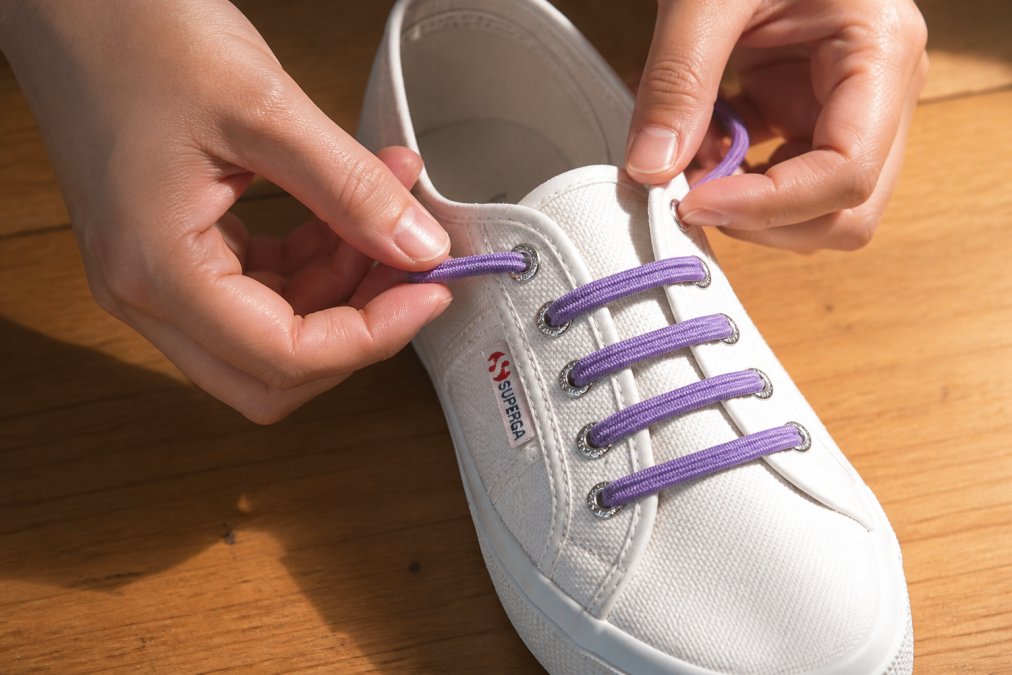
Step-by-Step Installation for uLace Kiddos
What you'll need: One pack of uLace Kiddos laces, the pair of sneakers, and about five minutes.
-
Remove the existing laces completely. Pull them out from every eyelet to see the eyelet layout clearly.
-
Start at the bottom eyelet pair. Take your first uLace segment and push one end through the bottom left eyelet from outside inward.
-
Pull the lace through until the anchor knot stops it. The anchor sits flush against the outside of the shoe.
-
Push the other end of the same segment through the bottom right eyelet, again from outside inward. Pull until both anchors are snug.
-
Move up one eyelet pair and repeat. Each segment covers one horizontal pair of eyelets. Work your way up the shoe.
-
At the top eyelet pair, thread the final segment and tuck any excess. The top lace should sit flat and not loop above the shoe's collar.
-
Test the fit. Slip the shoe on and off. The shoe should open enough to get the foot in without forcing, and close snugly when on. If too tight, leave the top eyelet pair empty. If loose, check that all anchors are fully seated.
Expected result: The shoe should feel like a well-fitted slip-on with no dangling lace ends and consistent snug fit from toe to ankle.
Durability, Material Quality, and Adaptive Needs
Elastic laces for kids face more stress than adult versions. Kids run, drag their feet, climb, and treat their shoes as equipment. The tensile strength of the elastic material determines how well the lace holds up under repeated stretching and compression.
The uLace Kiddos laces use stretchable fabric elastic construction that maintains its stretch capacity through regular use. The anchor system, the most common failure point in cheaper elastic laces, is designed to stay seated in the eyelet rather than pulling through over time.
For washability: most fabric elastic laces can go through a standard machine wash in a mesh laundry bag. Avoid high-heat drying, which degrades elastic fibers. Air drying preserves stretch capacity significantly longer.
Adaptive needs: No-tie elastic laces are classified as adaptive footwear solutions for children with conditions affecting fine motor control, grip strength, or hand coordination. This includes children with autism spectrum conditions, dyspraxia, developmental coordination disorder, juvenile arthritis, or low muscle tone. According to guidance on adaptive equipment for children with disabilities, adaptive tools that promote independence in daily living tasks are recommended as part of a broader support strategy. The Medium Grey uLace Kiddos option is specifically noted for autism-friendly use.
Choosing the Best Elastic Shoelaces for Kids: Quick Decision Guide
The right elastic shoelace depends on three variables: your child's shoe type, their foot width, and whether style or function is the priority.
| Situation | Best Choice | Why |
|---|---|---|
| Standard youth sneakers, any foot width | Any uLace Kiddos color | Designed specifically for youth shoe eyelets |
| Sensory-sensitive child | Medium Grey | Neutral, calm, tagged for autism-friendly use |
| Child who resists getting dressed | Rainbow or Shocking Pink | Color buy-in increases cooperation |
| School uniform / neutral look | White or Black | Matches any uniform sneaker cleanly |
| Wide feet | Any color, skip top eyelet | Reduces ankle tension, improves slip-on ease |
| Adaptive / mobility needs | Medium Grey or White | Consistent tension, easy to monitor fit |
| Gift or fun upgrade | Sparkly Metallic Silver or Graydient | Visual appeal, still fully functional |
The most common mistake is treating all elastic laces as interchangeable. Laces sized for adult shoes have different tension profiles than youth-specific versions. Using adult-sized elastic laces on a child's shoe often results in insufficient tension or an anchor that's too large to seat properly in a smaller eyelet.
uLace Kiddos are sized and tensioned for youth sneakers specifically. That's the practical difference between a lace that works and one that frustrates.
The uLace Kiddos system is modular, meaning each segment covers one eyelet pair. This means the same pack works across different shoe sizes because you simply use more or fewer segments depending on the eyelet count.
Parents navigating hectic mornings, adaptive footwear needs, or simply a kid who refuses to sit still long enough to tie their shoes will find elastic laces genuinely solve the problem. uLace has been the original creator of no-tie elastic shoelaces since 2009, and the Kiddos line applies that same push-and-pull anchor system to youth sneakers specifically. With 10 color options at $5.99 per pack, fast shipping from the USA, and the uLace Guarantee backing every purchase, it's a low-risk upgrade to your morning routine. Take the quiz on the uLace website to find the right color and style for your child's shoes.
Frequently Asked Questions
Q: Do elastic laces actually work for kids during sports and running?
A: Yes. Quality elastic shoelaces for kids maintain a snug fit through running and active play because the stretchable material distributes tension evenly across the foot rather than relying on a single knot. uLace Kiddos laces use a segment-based anchor system that keeps each eyelet independently tensioned, so the shoe stays secure even on the playground. The key is proper installation: each lace segment should be firm but not cutting off circulation.
Q: What are the best no-tie shoelaces for toddlers?
A: For toddlers, flat elastic laces in a kids-specific size are a good fit. uLace Kiddos are sized for smaller shoes and work with most standard sneaker eyelets. Look for laces with a simple push-and-pull installation that does not require tools, and choose a color your toddler will get excited about. The Rainbow and Shocking Pink options are popular with younger children who want to pick their own style.
Q: Can elastic laces help kids with fine motor skill delays or sensory needs?
A: Elastic no-tie laces remove the need to tie knots, which directly helps children who struggle with fine motor tasks due to developmental delays, autism, or sensory sensitivities. The easy-on easy-off slip-on experience reduces frustration and builds independence. uLace Kiddos Medium Grey is specifically tagged for autism-friendly use and offers a neutral look that avoids visual overstimulation while still providing a secure, comfortable fit.
Q: How long do elastic shoelaces for kids typically last?
A: Durability depends on material quality and how often the shoes are worn. Fabric elastic laces generally outlast silicone options in terms of maintaining tensile strength through repeated stretching and washing. uLace Kiddos laces are machine washable, which helps them hold up through daily school use. For most children wearing them five days a week, a well-made set should remain functional for a full school year before any noticeable elasticity loss.
Q: Will elastic laces work with my child's wide-fit sneakers?
A: Elastic laces are often a better fit for wide shoes than traditional laces because the stretchable material accommodates foot movement without over-tightening. You can adjust the tension during installation by pulling each segment more or less firmly before locking it in place. uLace Kiddos work with standard eyelets found on most kids' sneakers and tennis shoes, including wider styles. If your child's shoes have unusually small or thick eyelets, check the lace width before ordering.
This article was written using GrandRanker