




How to Store and Organize Extra Shoelaces at Home?
Last Updated: October 29, 2026
Quick Summary
Store extra shoelaces by giving each set a fixed home so it cannot tangle. Sort laces by color and length, coil each one loosely, and keep them in a divided shoe box, sock organizer, or wall-mounted board. Label each compartment or hook, and dry laces completely before storing them. Shoelace storage works best when each set has its own labeled spot.
- Sort laces by length first, since length is the category that most often sends people back to the drawer.
- A no-build compartment bin holds roughly 12 to 20 coiled lace sets and needs no tools.
- A 24-inch board with hooks spaced 2 inches apart holds 12 sets per row.
- Match the wrap to the lace: cardboard bobbins for flat laces, figure-eight coils for round and elastic laces.
- Dry laces completely before storing them, since trapped moisture causes mildew and stiffness.
Table of Contents
- Why Extra Shoelaces End Up Tangled in a Drawer
- Step 1: Gather and Sort Your Laces by Color and Length
- Step 2: Build a DIY Shoelace Organizer From Household Items
- Step 3: Keep Shoelaces From Tangling With Simple Wrapping Methods
- Organizing Extra Sneaker Laces by Collection Size
- Label Your System and Keep Laces Ready for Your Next Pair
- Frequently Asked Questions
Extra shoelaces have a way of ending up as a knotted ball at the bottom of a drawer, and proper shoelace storage prevents that from happening. Anyone who has dug through a junk drawer for a matching pair knows the frustration. A little organization fixes it, and you can do it with items you already own. Here are a few simple DIY ideas for storing and organizing extra shoelaces at home.
Why Extra Shoelaces End Up Tangled in a Drawer
Loose laces tangle because they have nothing holding them in place. Every time a drawer opens or closes, the laces shift and twist around each other. Over time, a few loose strands become a dense knot.
The fix is simple: give each lace a fixed home. Wrap, separate, and contain them so they cannot move around.
- Laces tangle when they sit loose in a pile
- Shoe boxes and drawers shake the pile every time you open them
- Separate, labeled sections keep each set easy to find
Step 1: Gather and Sort Your Laces by Color and Length
Start by pulling every spare lace out of drawers, bins, and shoe boxes. Put them all on a table so you can see what you actually have. Many people find they own more pairs than they realized.
Next, sort the laces into simple groups:
- By color: Keep neutrals together and bright colors together.
- By length: Group short laces for low-tops and long laces for high-tops.
- By type: Separate flat laces, round laces, and specialty laces.
Sorting first makes the rest of the process faster, and it shows you how much shoelace storage you actually need in containers or hooks.
Step 2: Build a DIY Shoelace Organizer From Household Items
This is the section most shoelace-storage articles skip: an actual build you can follow. Below are two projects, a no-build bin system and a wall-mounted board, with materials, dimensions, and steps. Pick the one that matches your space and how many laces you keep.
Project A: The No-Build Compartment Bin (15 minutes, no tools)
Best for renters and anyone who wants a setup they can undo in a minute. Capacity: roughly 12 to 20 coiled lace sets, depending on compartment size.
Materials
- One shoe box with a lid, or a fabric sock organizer with 12 to 24 slots (commonly sold for sock and underwear drawers)
- Cardboard from a shipping box, cut into dividers
- Rubber bands or twist ties
Steps
- If using a shoe box, cut cardboard strips to the box's interior height so they stand upright. A common layout is three strips running the long way and two running the short way, which creates 12 compartments in a standard box.
- Press the strips in so they fit snugly against the walls. No glue needed, friction holds them.
- Coil each lace loosely into a circle about 2 to 3 inches across and secure it with a rubber band or twist tie.
- Drop one coil per compartment and label the compartment, not the lace, with color and length.
- Store the box lid-off in a drawer or on a shelf so you can see the labels at a glance.
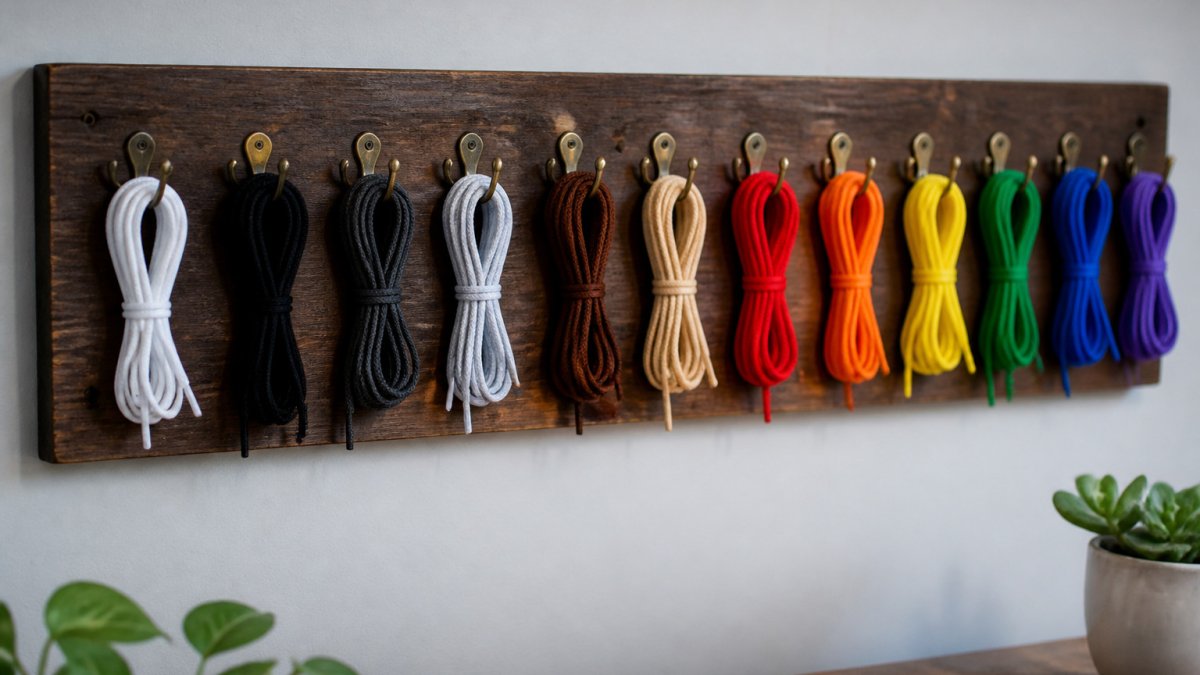
Project B: The Wall-Mounted Lace Board (about an hour, basic tools)
Best for closets, entryways, and anyone with more than 25 lace sets. Capacity: one hook per coiled set; a 24-inch board with hooks every 2 inches holds 12 sets per row.
Materials
- One 1x3 board (actual dimensions about 3/4 inch by 2-1/2 inches), cut to 24 or 36 inches
- Cup hooks, 1/2-inch to 3/4-inch size, one per lace set
- Two drywall anchors and screws sized for your wall
Steps
- Sand the board edges smooth, then paint or stain if you want a finished look. Let it dry fully before hanging.
- Mark hook positions along the center line, spacing them 2 inches apart. Two inches is enough for a coiled lace but tight enough that the board does not need to be long.
- Screw a cup hook into each mark by hand. If the wood is hard, start a pilot hole with a thin nail first.
- Find wall studs with a stud finder, or mark anchor points and drill for drywall anchors. Anchor the board with two screws, one near each end.
- Coil each lace, hang it on a hook, and add a small label above the hook with color and length. Maintaining this level of order helps establish a habit of organizing small accessories that can be applied to other cluttered areas like managing tangled cords in your vehicle.
Which Build Fits Your Space
- Drawer or shelf space only: Project A. It needs no wall and no tools.
- Closet wall or entryway: Project B. It keeps laces visible and frees shelf space.
- Renting or moving soon: Project A, or Project B hung from a removable adhesive strip rated for the board's weight.
Consumer product safety guidance on anchoring furniture and wall-mounted items
Step 3: Keep Shoelaces From Tangling With Simple Wrapping Methods
Wrapping is the step that decides whether your storage system works. A well-wrapped lace pulls out in one piece; a badly wrapped one becomes a knot the moment you touch it. Here are the methods that work, how to choose between them, and how to sort and preserve laces so they last.
Three Wrapping Methods, Compared
Bobbin wrap (cardboard spool)
- Cut a piece of cardboard about 3 inches by 4 inches. A cereal box works; corrugated shipping box cardboard is sturdier.
- Cut a small notch in each short end.
- Wind the lace around the long way, then tuck the ends into the notches.
Figure-eight coil
- Hold the lace by one end and loop it in a figure-eight around two fingers, keeping loops loose.
- Tuck the free end under the last loop to hold the shape. You can also see step-by-step lace styles to learn how laces are used and kept neat.
- Best for: round laces and elastic laces, which spring back if wound tight.
Loop and tie
- Coil the lace in loose loops about 3 inches across.
- Secure the middle with a twist tie or a small rubber band.
- Best for: quick storage and mixed collections where you are not sorting by type.
Sort by More Than Color
Color is the obvious category, but it is not the most useful one when you are hunting for a replacement. A practical sorting system uses four categories, in this order:
- Length: Short laces (commonly 27 to 36 inches) for low-tops, medium (about 45 inches) for most sneakers, long (54 inches and up) for high-tops and boots. Length is the category that most often sends people back to the drawer.
- Width and type: Flat laces, round laces, and elastic laces do not interchange well. Keep them apart.
- Color: Neutrals (white, black, gray) in one section, brights in another.
- Shoe compatibility: If a lace set belongs to a specific pair, note the shoe model on the label.
A simple label works: write length and color on masking tape, for example "45 in / black flat." Put the label on the compartment or hook, never on the lace itself, adhesive and ink can stain fabric laces.
Care Before Storage
Here are a few habits to consider before storing laces:
- Wash first. Check the lace for a care label if it has one.
- Dry completely. Air-dry flat on a towel or hang them. Do not coil or store a damp lace, trapped moisture is what causes mildew and stiffness.
- Keep out of direct sun. Long-term sun exposure fades dyed laces. Store bins in a drawer or closed closet rather than on a sunny shelf.
A Simple Inventory
A one-page inventory saves the most time of any step here.
The table below compares the three wrapping methods covered in this section so you can pick the one that suits each lace type.
| Method | Best for | Trade-off |
|---|---|---|
| Bobbin wrap (cardboard spool) | Flat and long laces | Takes more drawer space; cardboard can soften |
| Figure-eight coil | Round and elastic laces | Needs practice; can come undone in a crowded bin |
| Loop and tie | Quick storage, mixed collections | Rubber bands degrade; twist ties are gentler |
Organizing Extra Sneaker Laces by Collection Size
How you store laces depends on how many you have. A small collection needs a small solution, and a large one needs more structure.
- Under 10 pairs: A single shoe box or sock organizer is enough.
- 10 to 25 pairs: Use a divided bin or two sock organizers, sorted by color.
- More than 25 pairs: Combine a wall board for everyday laces with bins for backups.
Matching the system to your collection size keeps things from getting crowded. It also helps you see when you need to free up space.
Some people also keep a spare set of laces tucked in each pair of shoes.
Label Your System and Keep Laces Ready for Your Next Pair
Labels make any storage system easier to use. Write the color, length, or shoe type on a small sticker or piece of masking tape. Put the label on the container or the hook, not on the lace itself.
A quick habit helps the system last:
- Return each lace to its spot after you remove it
- Check labels once a season and remove any that no longer fit
- Keep a few spare laces in a labeled section for quick replacements
If you want a simpler alternative, consider uLace elastic, no-tie laces. They eliminate the hassle of tying and untying.
Frequently Asked Questions
How do you store extra shoelaces without tangling them?
Wrap each pair loosely around two fingers or a small piece of cardboard, then secure the ends with a rubber band or a twist tie. Keep the wrapped bundles upright in a box or drawer so they do not slide into each other. Loose coils tangle quickly, so avoid tossing laces into a pile. Labeling each bundle with its length also makes it faster to find the right pair when you need it.
What is the best way to organize shoelaces?
Sort laces by color first, then by length, since most people reach for a specific color or size when replacing a worn pair. A clear storage box with dividers works well for small collections, while a wall-mounted board suits larger ones. Keep the system simple enough that you can maintain it without effort. Check your organizer every few months and remove laces you no longer use.
What household items can I use as a shoelace organizer?
Common options include sock organizers, small shoe boxes, clear plastic food containers, and empty tissue boxes. A sock organizer with individual pockets is especially useful because each pocket holds one pair. Cardboard tubes from paper towels can store rolled laces upright. Choose containers that let you see the contents, so you can find a color without digging.
How do I keep extra sneaker laces from getting lost?
Keep all spare laces in one designated spot near your shoes, such as a closet shelf or entryway bin. Pair each set of laces with the sneakers it fits so you know which pair they belong to. Labeling each bundle with the shoe name or size reduces searching. Storing laces in the same container every time prevents them from scattering across the house.
