




Do Elastic Laces Stay Secure? The 2026 Truth
Table of Contents
- How Elastic Laces Actually Lock In Place
- How to Install No-Tie Laces the Right Way
- How to Adjust Tension on Elastic Laces for a Snug Fit
- Benefits of Elastic Shoelaces for Runners
- Durability and Long-Term Material Fatigue
- Troubleshooting Slippage and Common Mistakes
- Frequently Asked Questions
Last Updated: September 13, 2026
How Elastic Laces Actually Lock In Place
Do elastic laces stay secure? Yes, when the locking mechanism is designed well. Elastic laces stay secure through a combination of a locking closure, a cord clip, and the natural tension created when the lace stretches across your instep. Unlike traditional laces that rely on a knot, no-tie shoelaces use a spring-loaded or cam-style fastener that grips the lace at whatever tension you set.
The stretch itself does the heavy lifting. Elastic laces maintain constant compression across the top of your foot, so the shoe stays snug even as your foot moves. That is the core difference between a fastening system built for movement and a knot that loosens the moment you start walking.
This guide from uLace covers how the lock works, how to install and adjust it, and where cheap systems fail.
How to Install No-Tie Laces the Right Way
Installing no-tie laces takes about five minutes per shoe. Thread the lace through your eyelets in a crisscross pattern, feed both ends through the cord clip, and slide the clip down until the fit feels snug. No knot required.
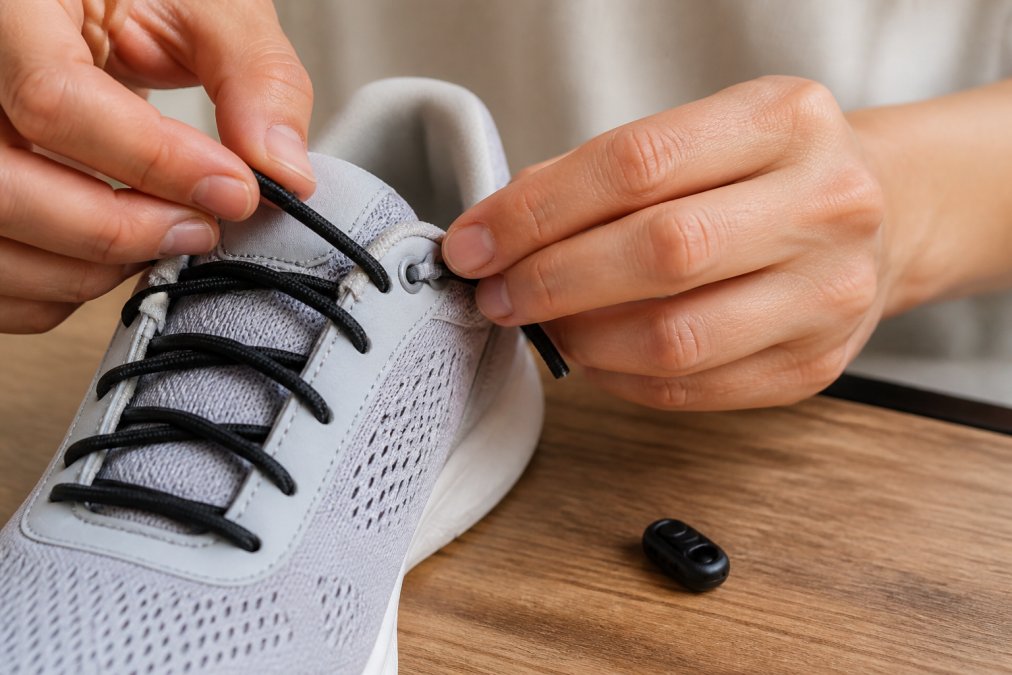
A common mistake is threading too loosely at the bottom eyelets. Start tight near the toe and keep the lace flat so it does not twist. Twisted lace creates pressure points and shortens the life of the elastic. uLace uses a simple push-and-pull method that avoids the fiddly threading some systems require.

Eyelet Compatibility: Which Shoe Types Work Best
Most standard sneakers with round or oval eyelets work with elastic laces. Shoes with unusually narrow eyelets or decorative grommets can be harder to thread, so check the opening before you buy. Wider eyelets let the lace slide freely, which keeps tension even across the whole shoe. Properly fitted eyelets ensure that the tension remains consistent while maintaining your sneakers in a condition that helps you distinguish genuine craftsmanship from counterfeit alternatives.
How to Adjust Tension on Elastic Laces for a Snug Fit
Adjusting tension on elastic laces comes down to one move: slide the cord clip toward your toes for a tighter fit, or away for a looser one. Set it, then walk a few steps to confirm the heel stays locked in place. That is the simple version. The technical version explains why the clip holds at all, and how to tune it so it holds under real load.
What Actually Holds the Lace in Place
A cord clip is a cam-lock or spring-loaded toggle. Inside the housing, a small spring presses a cam or a serrated jaw against the lace. When you pull the lace through, the jaw bites into the weave and resists backsliding. The holding force comes from friction between the jaw and the lace surface, multiplied by the spring pressure. That is why a worn, shiny, or frayed lace slips even when the clip is new, the surface it grips has changed.
Most practitioners find that a clean, dry lace in good condition holds firmly under normal walking and running loads. The failure point is almost always the lace surface, not the clip.
The Heel Lock and Runner's Loop Technique
For a genuinely secure fit, do not rely on the clip alone. Use a heel lock (also called a runner's loop) at the top two eyelets:
- Thread the lace normally up to the second-to-last eyelet.
- Instead of crossing straight to the last eyelet, run each lace end back through the loop formed between the last two eyelets on the same side.
- Pull the loops snug, then feed both ends through the cord clip.
This creates a pocket that cups the heel and prevents it from sliding forward. It is the same technique distance runners use with traditional laces, and it works with elastic laces because the loop adds a mechanical anchor point independent of the clip's grip.
Adjusting for Foot Swelling Through the Day
Feet expand through the day, so a fit that feels perfect in the morning can feel tight by afternoon. Elastic laces handle that automatically because they stretch, which is why many runners prefer them over fixed cotton laces. If the shoe feels loose, nudge the clip down a notch rather than re-threading. If it feels tight, slide the clip up a quarter inch and walk a few steps before deciding.
A common pattern is to set tension once in the morning and again after a long walk or run. The lace does not need constant re-tuning, but it does need a check after the first few wears while the elastic settles into its working range.
Tension by Use Case
| Use Case | Clip Position | Heel Lock? |
|---|---|---|
| Daily walking | Mid-range, comfortable | Optional |
| Running | Snug, top eyelets tighter | Recommended |
| Triathlon transition | Pre-set, slip-on | Recommended |
| Arthritis or limited dexterity | Loose enough to slip on | Optional |
For anyone with arthritis or limited hand strength, the goal is the opposite of a runner's: set the clip loose enough that the foot slides in without resistance, then tighten only if the shoe feels unstable. Elastic laces remove the need to bend and tie entirely, which is why they are common in adaptive footwear.
Benefits of Elastic Shoelaces for Runners
The benefits of elastic shoelaces for runners start with transition speed. In a triathlon, every second in the transition zone counts, and slip-on convenience removes the fumbling that comes with wet, knotted laces.
Beyond racing, elastic laces reduce pressure points. Traditional laces concentrate force where you tie them; elastic spreads tension evenly across the instep. That even compression supports foot stability without cutting off circulation. For anyone dealing with foot swelling on long runs, the stretch keeps the fit comfortable mile after mile.
Durability and Long-Term Material Fatigue
Elastic laces typically last one to two years of daily wear before the stretch weakens. That range is wide because the real variable is not time, it is stretch cycles. Material fatigue is the slow loss of elasticity that happens as the fibers relax over thousands of stretch cycles. Each time you put the shoe on, the lace stretches; each time you take it off, it retracts. Over months, the polymer chains in the elastic lose some of their ability to return to their original length.
What Accelerates Fatigue
Three factors speed up the process:
- Heat. Leaving shoes in a hot car or near a radiator relaxes the elastic fibers faster than normal wear.
- UV exposure. Direct sunlight breaks down the elastic over time, especially on shoes stored outdoors or on a sunny windowsill.
- Abrasion at the eyelets. Every pass through an eyelet rubs the lace surface. Rough or sharp eyelet edges act like sandpaper.
A lace that is stretched and released 20 times a day will fatigue faster than one used twice a day, even if both are the same age. That is why a runner who laces up for daily training may see wear in under a year, while a casual wearer may get two or more.
How Shoe Material and Eyelet Type Affect Wear
This is where most guides stop short. The shoe matters as much as the lace:
- Mesh uppers with plastic or metal eyelets. The eyelet is the wear point. Smooth, rounded eyelets let the lace slide freely and distribute tension evenly. Sharp or molded-in eyelets can fray the lace.
- Leather uppers with punched eyelets. Leather eyelets are often smoother than metal, but they can stretch over time, changing the angle the lace enters at and creating a new rub point.
- Decorative or unusually narrow grommets. These restrict lace movement, which concentrates tension at one spot and shortens lace life. Check the opening before you buy.
- Wide, oval eyelets. These are the most forgiving. The lace slides freely, tension stays even across the whole shoe, and the lace surface wears more slowly.
If your shoes have narrow or sharp eyelets, expect to replace laces sooner, or consider a lace with a smoother, tighter weave.
Signs It Is Time to Replace Them
- The lace no longer snaps back after you stretch it
- The cord clip slides on its own during wear
- You notice fraying near the eyelets
- The lace feels flat or stiff rather than round and springy
- The clip needs to be tightened more often than it used to
A Simple Pre-Run Test
Before a long run or a race, stretch a section of the lace between your fingers and release it. A healthy elastic snaps back immediately. A fatigued lace returns slowly or stays stretched. If it stays stretched, replace it before you run, a lace that fails mid-run is a safety issue, not just an inconvenience.
Maintenance That Extends Life
Store shoes out of direct sunlight and avoid leaving them in a hot car. Hand-wash laces in cool water with a mild soap if they get dirty, then air-dry them away from heat. Do not put them in a dryer. uLace has been making no-tie laces since 2009, and its ProFormance line is built for repeated stretching without losing grip, but even a well-built lace benefits from basic care.

General guidance on shoe care and storage
Troubleshooting Slippage and Common Mistakes
Slippage almost always traces back to one of three causes: the clip is too loose, the lace is threaded unevenly, or the lace has fatigued. Fix the first two by re-threading and sliding the clip tighter. If the lace has lost its stretch, replace it.
| Problem | Likely Cause | Fix |
|---|---|---|
| Lace slides during wear | Clip too loose | Slide clip toward toes |
| Uneven tightness | Twisted threading | Re-thread flat |
| No stretch left | Material fatigue | Replace lace |
| Heel slips out | Top eyelets loose | Tighten top two eyelets |
For people with arthritis or limited hand strength, elastic laces remove the need to bend and tie entirely. One uLace customer put it simply: "I'm 72 and it's hard for me to bend over all the time to tie my shoelaces... Now I just slip my foot thru my shoes and that's it."
Frequently Asked Questions
How do you secure elastic shoelaces so they don't slip?
Elastic laces stay secure through two mechanisms: a locking closure (cord clip or toggle) that pinches the lace, and the natural stretch of the elastic returning to its resting length. Thread the lace through every eyelet, pull both ends to your preferred tension, then slide the cord clip down until it sits flush against the top eyelet. For extra hold during sports, run the lace through the top eyelet twice to create a runner's loop before attaching the clip.
Do elastic laces loosen over time?
The elastic itself will gradually lose some rebound with heavy daily use, but the locking mechanism is what keeps the lace from slipping during wear. If you notice the clip no longer grips firmly, that's usually the first sign of wear, and replacing the clip or the lace set restores the original hold.
Are elastic laces suitable for competitive running?
Yes. Elastic laces with a reliable locking closure are used by triathletes and distance runners because they eliminate re-tying during transition and keep consistent pressure across the instep. The key is getting the tension right: too loose and your foot slides forward on downhills, too tight and you lose circulation on long runs. A heel lock lacing pattern paired with elastic laces gives the foot stability competitive runners need.
What if my elastic laces feel too loose around the ankle?
Loose ankle fit usually means the lace isn't routed through the top eyelets correctly or the cord clip isn't seated close enough to the shoe. Pull the clip down until the lace compresses slightly against the top of your foot, then test with a few steps. If the heel still lifts, try a runner's loop through the top eyelet pair. For people with narrow heels or high arches, this extra loop creates a heel lock that holds the foot back without adding pressure points.
Elastic laces stay secure when the locking mechanism, threading, and tension are set correctly. If you want a system designed for a reliable slip-on fit, uLace offers elastic no-tie laces with easy installation, a range of styles and colors, and fast shipping. Get started with uLace and turn the sneakers you love into hassle-free slip-ons.