




Elastic Laces for Wide Feet: A 2026 Comfort Guide
Table of Contents
- Why Standard Laces Fail Wide Feet (And What to Do)
- How Elastic Laces for Wide Feet Improve Fit and Comfort
- Shoelace Length Guide for Wide Feet: Getting the Right Size
- How to Lace Shoes for Wide Feet: Techniques That Work
- Best No-Tie Laces for Running and Everyday Wear
- Durability, Materials, and Tension Over Time
- Elastic Laces for Wide Feet: What to Expect
- Conclusion
- Frequently Asked Questions
Last Updated: September 7, 2026
Why Standard Laces Fail Wide Feet (And What to Do)
Standard shoelaces fail wide feet because they compress the midfoot and restrict natural forefoot splay, creating pressure points that worsen with every step. A traditional lace system forces the two sides of the shoe together, squeezing the top of your foot and often causing discomfort, numbness, or aggravating conditions like bunions (peer-reviewed research). The fix is straightforward: replace the rigid lace with a stretchable alternative that adapts to your foot's actual volume and shape.
Elastic laces solve this by distributing tension evenly across the instep rather than concentrating it at the tightest eyelet. This is why more footwear specialists now recommend stretch laces for anyone with wide feet, high arches, or swelling during the day. At uLace, we help people convert their favorite sneakers into comfortable slip-ons. We often hear that the pressure relief is immediate.
Below, we'll walk through precisely how elastic laces improve fit, how to choose the right length, and which lacing patterns work best for wide feet. We'll also cover durability so you know what to expect before you buy.
How Elastic Laces for Wide Feet Improve Fit and Comfort
Elastic laces improve fit by converting static tension into dynamic, forgiving pressure that moves with your foot through the gait cycle. Unlike cotton or nylon laces that stay at one tightness, elastic material stretches during weight-bearing moments and relaxes when your foot is unloaded. This directly addresses the two biggest complaints from wide-footed wearers: tightness across the instep and inadequate toe room.
The ergonomic benefit is significant for people managing foot volume changes. Many individuals experience natural foot swelling by afternoon or after long periods standing, a condition often related to edema (the CDC). A rigid lace that fit comfortably in the morning becomes a tourniquet by evening. Elastic laces accommodate that expansion, maintaining a secure hold without cutting off circulation.
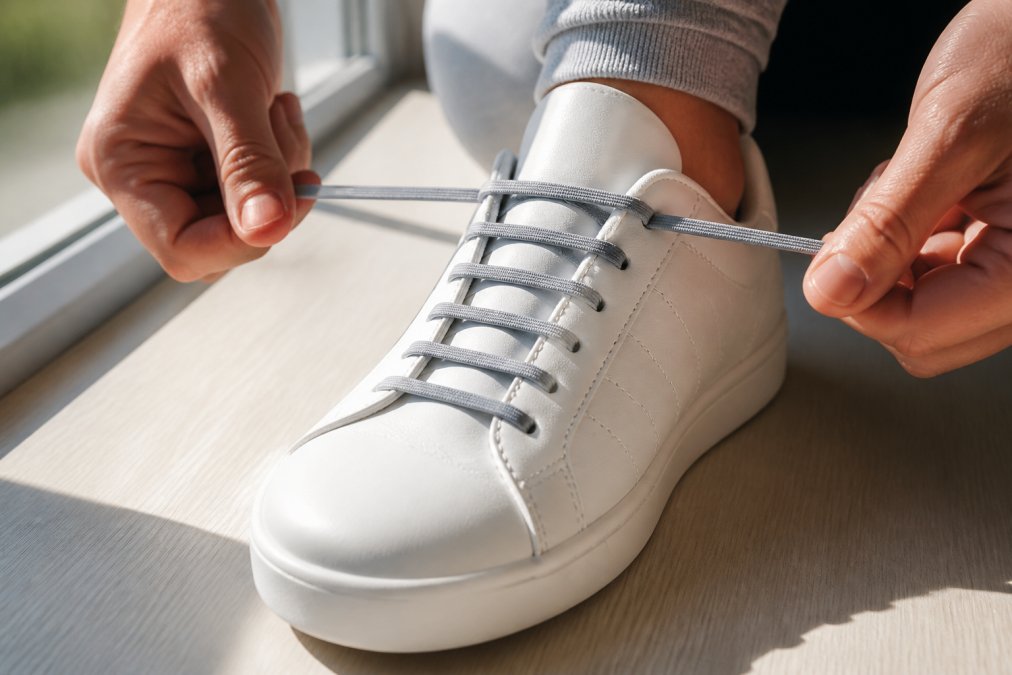
The comfort difference also extends to the toe box. When laces stretch, they reduce the downward pressure that pushes your foot forward into the front of the shoe, helping prevent toe crowding and allowing natural splay. A snug fit around the heel and midfoot, combined with relaxed pressure over the toes, is the ideal balance for wide-footed runners and walkers.
Shoelace Length Guide for Wide Feet: Getting the Right Size
Choosing the correct lace length is the most common source of frustration, leading to laces that are either too short to thread or so long they look sloppy. For wide feet, measure your current laces, since the shoe's eyelet count matters more than the shoe size alone. A wide-fit shoe of the same size often has a higher volume, which can require a slightly longer lace to accommodate the extra distance between eyelets.
Measuring Your Current Laces
Remove the lace from your shoe and lay it flat. Measure from the tip of one aglet to the tip of the other, excluding any knots. Record this length in inches, then compare it against the sizing chart of the elastic lace brand you are considering. If you are between sizes, size up rather than down, as you can always trim excess length on most no-tie systems.
uLace Sizing Options for High-Volume Shoes
For shoes with a standard eyelet count of five to six pairs, the uLace Classic - Black at $6.49 covers most mid-volume sneakers. For high-volume shoes, low-top sneakers with a wide toe box, or styles where you want a cleaner look, the uLace Shorts - Plum Purple at $12.99 or the uLace Shorts - Peachy Orange at $12.99 are the better picks. The Shorts design is ideal for converting classic sneakers into easy slip-ons without excess lace bulk across the instep.


| Lace Style | Best For | Eyelet Count | Price |
|---|---|---|---|
| uLace Classic | Standard mid-volume sneakers | 5-6 pairs | $6.49 |
| uLace Shorts | Wide toe box, low-top, high-volume | 4-6 pairs | $12.99 |
| uLace Kiddos | Children's wide-fit shoes | 4-5 pairs | $5.99 |
For children with wide feet, the uLace Kiddos - Medium Grey at $5.99 offers the same stretch benefits in a smaller profile, making school morning routines faster for parents and easier for kids who struggle with fine motor coordination.

How to Lace Shoes for Wide Feet: Techniques That Work
Standard criss-cross lacing pulls the eyelets together evenly, creating a 'V' shape that squeezes the widest part of your foot. For wide feet, the goal is to control where that tension lands and to create more horizontal volume. Pairing the right lacing pattern with elastic laces amplifies the benefit, as the stretch material works with the geometry you create, not against it.
The 'Window' Lacing Pattern for High-Volume Insteps
This is the most effective technique for reducing pressure across the top of the foot, a common complaint for those with high arches or midfoot swelling. Instead of crossing the laces diagonally over the instep, you create a straight, horizontal 'window' that relieves pressure at the highest point of your foot.
Step-by-step:
- Start at the bottom: Thread the elastic lace through the bottom pair of eyelets so the ends are even.
- Cross and thread: Cross the laces and thread them through the second pair of eyelets as you normally would.
- Create the window: At the third or fourth eyelet pair (where your arch is highest), do not cross the laces. Instead, thread each end straight up into the eyelet directly above it on the same side. This creates a horizontal bar across the shoe.
- Resume crossing: Continue crossing the laces for the remaining eyelets up to the top.
This technique reduces downward force on the instep. When combined with elastic laces, the 'window' area allows the material to give vertically, accommodating swelling without creating a tourniquet effect.
The 'Toe Box' Opener for Forefoot Splay
For forefoot width and conditions like bunions or tailor's bunions, the goal is to maximize space in the toe box. The simplest modification is to skip the first set of eyelets closest to the toes.
Step-by-step:
- Skip the first row: Begin lacing at the second pair of eyelets from the toe.
- Thread straight across: Run the lace straight across the bottom (between the second eyelets) before crossing up to the third.
- Continue standard lacing: Use a standard criss-cross pattern for the rest of the eyelets.
This action pulls the sides of the shoe together further back, allowing the forefoot to splay naturally without the rigid constraint of the first eyelet. It is a highly effective method for converting a standard sneaker into a more accommodating fit for wide feet.
Why These Patterns Matter More with Elastic Laces
With traditional laces, these patterns often fail because the non-stretch material creates a fixed pressure point. Elastic laces solve this. The stretch material distributes the load evenly across the entire lacing field, so the 'window' doesn't just relieve pressure, it actively absorbs shock and allows for dynamic volume changes as you walk. This combination of geometric lacing and material stretch is the most effective non-custom solution for wide-foot discomfort.
A common mistake is to combine a wide-foot lacing pattern with over-tightening. The pattern creates the space; the elastic lace provides the give. Set the tension so the shoe feels snug but not constricting, allowing for natural foot expansion during weight-bearing.
By mastering these two patterns, you move beyond simply swapping laces and start actively engineering the fit of your shoe to match the biomechanics of your wide foot.
Best No-Tie Laces for Running and Everyday Wear
For running and everyday wear, the best no-tie laces offer a balance of stretch capacity and a secure locking mechanism that prevents slippage during explosive movements. Quality elastic laces address this with a tension adjustment system that lets you set the baseline tightness once, then rely on the material's stretch for movement.
uLace is the original creator of no-tie elastic shoelaces, a distinction that matters when evaluating durability and design. The push-and-pull installation method means you thread the lace once, pull to tighten, and the locking mechanism holds firm until you release it. This prevents the shoe from feeling loose around the heel, a common complaint with cheaper stretch laces that lack a proper tension lock.
The best no-tie lace for running is not necessarily the stretchiest one. A lace with too much give will feel unstable during lateral movements. The ideal running lace provides enough stretch to slip on and off easily but is firm enough to keep the heel locked during a stride. For everyday wear, a slightly softer stretch improves all-day comfort, which is why uLace offers different styles rather than a one-size-fits-all product.
Durability, Materials, and Tension Over Time
A legitimate concern with elastic laces is whether they lose their stretch after months of use. The answer is a definitive 'yes' for all elastic materials, the question is how much and how fast. Understanding the material science will help you choose a lace that maintains its performance for years, not months.
The Physics of Elastic Degradation
Elastic laces rely on two primary components: a core of elastic fibers (often natural rubber or synthetic polyisoprene) and a braided or woven outer sheath (typically polyester or nylon). The elastic core provides the stretch, while the sheath protects it from abrasion and UV light.
Over time, the elastic core undergoes fatigue. Every stretch cycle causes micro-tears in the polymer chains. This is not a defect; it is the physical limit of the material. The rate of fatigue is influenced by three factors:
- UV Exposure: Sunlight breaks down the polymer bonds in both natural and synthetic rubber. A lace left on shoes in a sunny car or near a window will degrade significantly faster than one stored indoors.
- Abrasion: Friction against the eyelets, especially metal ones, can fray the outer sheath. Once the sheath is compromised, the inner elastic core is exposed to dirt and grit, accelerating wear.
- Frequency and Intensity of Stretch: A lace used for daily running will fatigue faster than one used for casual walking. The depth of stretch also matters, over-stretching a lace beyond its designed capacity (e.g., forcing it onto a shoe that is too small) causes permanent deformation.
What 'Loss of Tension' Actually Feels Like
After 6-12 months of heavy use, you will notice the lace feels 'looser' at the same tension setting. It still stretches, but the resting state is longer, and the return force is weaker. This is tension degradation. For a wide-foot user, the shoe may feel less supportive over the midfoot, and you may need to re-tighten the lace more frequently to maintain the same level of security.
A high-quality elastic lace will lose some of its initial tension over the first year of daily use, then plateau. A low-quality lace can lose more in the same period, becoming functionally useless as a secure fastener.
Material Safety and Skin Contact
For those with sensitive skin or allergies, the material composition is critical. Many cheaper elastic laces are made with natural rubber latex, which is a common allergen. Symptoms can range from mild contact dermatitis (redness, itching) to more severe reactions (medlineplus.gov).
Look for laces that are explicitly latex-free and made from synthetic polymers like thermoplastic polyurethane (TPU) or silicone. These materials are inherently hypoallergenic and do not contain the proteins found in natural latex that trigger allergic responses.
Additionally, check for compliance with the Consumer Product Safety Improvement Act (CPSIA) of 2008, which restricts lead and phthalates in products intended for children. A reputable manufacturer will state compliance with this standard on their packaging or website.
The uLace Approach to Longevity
Since 2009, uLace has engineered its laces to address these specific degradation points. The outer sheath uses a tight, braided polyester weave that resists abrasion from eyelets. The elastic core is a proprietary blend designed to maintain its return force over thousands of cycles. The locking mechanism is also a critical component, it allows you to set the tension without over-stretching the core, preventing premature fatigue.
When evaluating elastic laces, ask two questions: 'Is it latex-free?' and 'What is the expected lifespan of the elastic core?' A lace that costs $6 but needs replacing every 6 months is more expensive than a $13 lace that lasts 2 years. The uLace Guarantee covers defects in materials and workmanship.
To maximize the lifespan of any elastic lace, store your shoes away from direct sunlight and avoid machine washing, which can accelerate abrasion. Hand-washing with mild soap and air-drying will extend the life of the elastic core significantly.
Elastic Laces for Wide Feet: What to Expect
Switching to elastic laces for wide feet delivers three measurable outcomes: easier on-and-off access, reduced pressure points, and a cleaner aesthetic without dangling laces. The adjustment period is short, usually a day or two, as you fine-tune the tension to your preferred snugness.
Expect to eliminate the daily frustration of retying laces that come undone, a benefit that resonates strongly with older adults who find bending difficult. One uLace customer in their 70s noted how hard it is to bend over repeatedly to tie shoelaces, and the switch to a slip-on system removed that barrier entirely. For parents, elastic laces mean kids can put on their own shoes without help, fostering independence and cutting down morning routine time.
The trade-off is that elastic laces change the feel of your shoe. The fit is different from a rigid, locked-down lace. For most people with wide feet, this change is a welcome improvement, but the secure hold comes from tension management rather than a hard knot. If you are coming from traditional laces, expect a transition period where the give of the material feels unfamiliar, then quickly becomes indispensable.
Conclusion
Wide feet demand footwear that adapts, and standard laces simply do not. The combination of the right length, a lacing pattern that relieves instep pressure, and quality elastic material transforms any sneaker into a comfortable, supportive slip-on. The challenge is finding a system that balances stretch with security, which is where uLace's push-and-pull locking design and range of styles make the difference. Get started with uLace and turn the sneakers you love into hassle-free slip-ons that fit comfortably all day.
Frequently Asked Questions
Do elastic shoelaces really work for wide feet?
Yes, elastic laces work well for wide feet because they stretch to accommodate higher foot volume. Unlike rigid laces, they distribute pressure evenly across the instep, reducing pinch points and discomfort. This makes them a practical choice for people with bunions, swelling, or high arches who struggle with traditional lacing.
What lace pattern is best for wide feet?
For wide feet, a straight bar or parallel lacing pattern is best. This method runs the lace horizontally across the shoe, which opens the sides and gives the toe box more room. Combined with elastic laces, this technique prevents the tight 'V' shape that squeezes the top of the foot.
Are elastic laces adjustable for different foot widths?
Yes, uLace elastic laces offer tension adjustment. You can pull the lace tighter or looser before locking the clasp to customize the fit for your specific foot volume. This is useful if your feet swell during the day, as you can adjust the tension without unlacing the entire shoe.
How long do elastic laces last before they lose their stretch?
uLace elastic laces are designed for daily use. The material resists tension degradation, meaning the stretch does not wear out quickly. They are durable enough for athletic performance and hold up well to repeated slipping on and off, making them a long-lasting alternative to standard laces.