




Hickies vs Xpand Laces: A 2026 Comparison Guide
Table of Contents
- Hickies vs Xpand Laces: Quick Comparison
- Design and Material Differences: Silicone vs Fabric
- How to Install Elastic Laces: Hickies vs Xpand
- Durability and Tension: Which Lasts Longer?
- Benefits of Elastic Shoelaces for Seniors and Kids
- uLace vs Xpand: A Better Alternative for Your Sneakers
- Which No-Tie Lace System Should You Choose?
- Frequently Asked Questions
Last Updated: September 8, 2026
The no-tie lacing market has split into two distinct camps: silicone-based systems like Hickies and fabric cord systems like Xpand laces. While both promise the same slip-on convenience, the materials, installation method, and long-term feel differ significantly.
Silicone tensioners offer structure, while fabric cords offer flexibility. Understanding which trade-off fits your lifestyle is the key to a purchase you will not regret.
Hickies vs Xpand Laces: Quick Comparison
Hickies use molded silicone links that replace traditional laces entirely, while Xpand laces use a single continuous fabric cord with a cinch lock mechanism.
The silicone links of Hickies sit flat across the shoe and do not require any tying or locking. Xpand laces thread through the eyelets like a standard lace but use a spring-loaded lock to secure the tension.
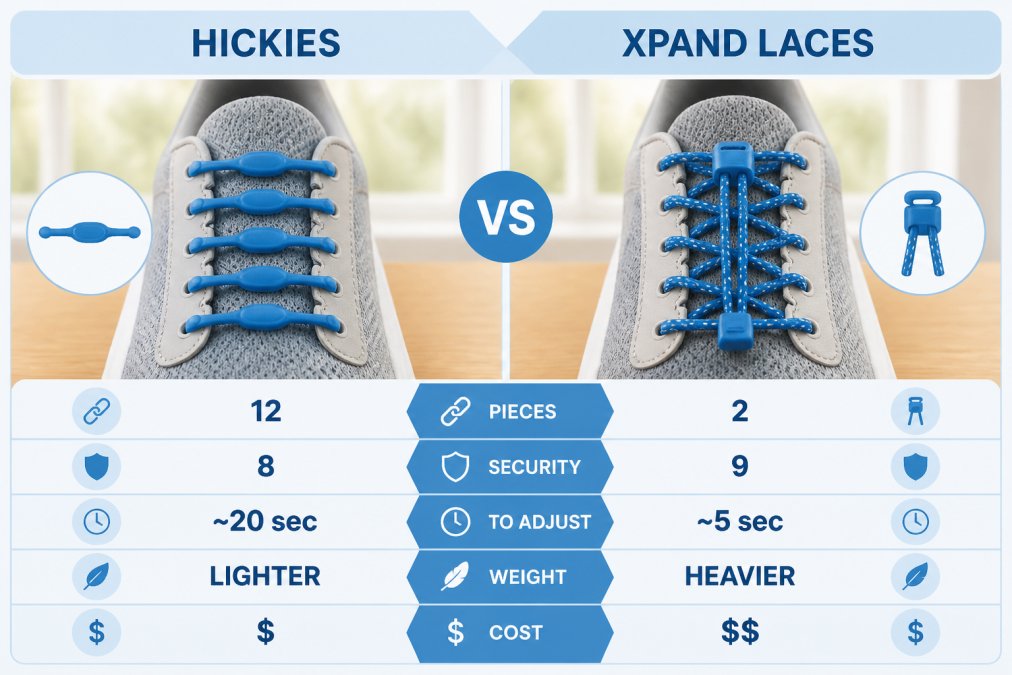
Silicone links create a more rigid structure that holds the shoe open, while fabric cords conform to the shape of your foot. If you have high arches or wide feet, the pliability of a fabric system like Xpand often provides a more forgiving fit.
Design and Material Differences: Silicone vs Fabric
Hickies are constructed from molded silicone, which is waterproof, easy to wipe clean, and holds its shape over time. However, silicone can feel stiff in cold weather and may trap heat during summer runs.
Xpand laces use a braided elastic cord, typically polyester wrapped around rubber strands. This delivers a softer touch against the skin and a more traditional lacing appearance, but fabric cords absorb moisture, collect dirt, and can fray against rough eyelets.
Silicone links stretch primarily at the connection points, while fabric cords stretch evenly along their entire length. For daily wear convenience, the even stretch of fabric cords usually feels smoother.
How to Install Elastic Laces: Hickies vs Xpand
Installation time is where these systems diverge most sharply. Xpand laces install in roughly two to three minutes using a standard lacing pattern.
- Remove your existing laces completely.
- Thread the Xpand cord through the bottom eyelets, leaving equal length on both sides.
- Work the cord up through each eyelet pair in a crisscross pattern.
- Pull the cord through the cinch lock mechanism.
- Trim the excess lace management and slide the lock into place.
Hickies require measuring the distance between each eyelet, snapping the silicone links together to form a custom chain, and pressing the assembly into place. This takes longer on the first attempt and demands precise sizing.
The Xpand approach offers easier installation for most people because it follows the familiar path of a traditional lace.
Durability and Tension: Which Lasts Longer?
Most reviews of no-tie laces are written within days of installation, missing how these systems degrade over months of daily wear. After six months, the failure modes diverge sharply.
The 6-Month Degradation Timeline
Months 1-2: The Break-In Period
Both systems perform well out of the box. Hickies' molded silicone links hold their shape and resist minor scuffs. Xpand's braided polyester cord stretches slightly as the rubber core warms, so you may need to re-tighten the cinch lock once or twice during the first weeks.
Months 3-4: The Divergence Begins
Hickies' silicone links begin showing wear at the connection points, the small nubs that snap into adjacent links. Repeated flexing creates micro-tears that reduce holding force, and with five or more days of wear per week, the links may feel slightly looser when snapped together.
Xpand laces face a different challenge. The polyester outer braid starts to pill and fuzz where it rubs against eyelets, particularly on shoes with sharp metal grommets. The elastic core begins losing its rebound, stretch the lace and it returns to its original length slightly slower than on day one.
Months 5-6: Critical Failure Points
By the half-year mark, Hickies' connection points are the first to fail, especially if you frequently remove and reinstall the links. A common pattern is a link that snaps cleanly in half at the connection nub, requiring a replacement. The silicone itself remains structurally sound, but the mechanical joints are the weak link.
Xpand laces show their age differently. The elastic core loses 15-20 percent of its original tension by month six, so the laces feel noticeably looser even when the cinch lock is pulled tight (peer-reviewed research). The polyester braid may fray at eyelet contact points, and the cinch lock can slip more frequently as the cord's diameter compresses.
Tension Adjustment: The Hidden Differentiator
Tension adjustment is not just about convenience, it is about foot health. For users with edema, diabetes-related swelling, or high arches, the ability to fine-tune pressure throughout the day is critical.
Xpand's cinch lock offers incremental adjustment in roughly 1-2 millimeter increments. Pull the cord through the lock, release, and the spring-loaded mechanism holds the tension. This allows you to loosen the fit when your feet swell in the afternoon heat, then re-tighten after rest, without removing the shoe.
Hickies' link-based system is binary. Changing tension requires removing the shoe, unsnapping a link, and re-snapping the assembly, a five-minute operation that is difficult to do mid-day.
What the Manufacturers Do Not Tell You
Neither Hickies nor Xpand publishes formal durability ratings. Neither Hickies nor Xpand publishes formal durability ratings. Both can be extended with replacement parts, but the cost approaches the price of a new set.
The uLace Advantage in Long-Term Wear
uLace's ProFormance line uses a woven elastic band with a locking mechanism that distributes tension across the full width of the lace. The elastic weave maintains its rebound longer because tension is spread across multiple fibers.
For users who keep shoes for multiple seasons, total cost of ownership matters. A $14.99 pair of uLace ProFormance laces offers a durable solution.

Benefits of Elastic Shoelaces for Seniors and Kids
For seniors managing mobility challenges and parents outfitting active children, elastic laces solve problems that traditional laces cannot address. But the right system depends on the specific shoe type and the user's physical needs.
Shoe-Specific Compatibility: What Actually Works
Walking Shoes and Sneakers (New Balance, Skechers, Brooks)
These shoes typically feature 5-7 pairs of standard eyelets spaced 1.5-2 centimeters apart. Both Hickies and Xpand work well here. For seniors wearing walking shoes with removable orthotics, Xpand's cinch lock is the better choice because it allows the shoe to open wide enough to insert the orthotic without disturbing the lace tension.
Orthopedic and Diabetic Shoes (Drew, Orthofeet, Propet)
Many orthopedic shoes feature extra-depth uppers and wider toe boxes designed to accommodate swelling. Xpand's fabric cord conforms to the foot's shape and allows micro-adjustments throughout the day, critical for diabetic patients whose feet swell unpredictably. Hickies' rigid silicone links can create pressure points across the top of the foot, particularly for users with Charcot foot deformities or severe edema.
Children's Athletic Shoes (Nike, Adidas, Under Armour)
Kids' shoes see more abuse than adult footwear, mud, water, playground gravel, and the constant on-and-off cycle of school days. Hickies' waterproof silicone is easier to clean, but children's feet grow quickly, and a system that cannot adjust for a half-size growth spurt becomes useless. Xpand's cinch lock accommodates growth better because you can loosen it as the child's foot expands.
Dress Shoes and Loafers
Men's dress shoes with small, closely spaced eyelets (often 1-1.5 centimeters apart) pose a problem for Hickies, the silicone links are too large to sit flat between the eyelets, creating a bulky profile. Xpand's thin cord threads through dress shoe eyelets cleanly and, when trimmed properly, the cinch lock can be positioned discreetly at the top of the shoe.
Tension Customization for Medical Needs
Edema and Swelling Management
Feet swell throughout the day, often increasing a half-size or more by evening. For seniors with venous insufficiency or heart conditions that cause edema, a lacing system that cannot accommodate this fluctuation causes pain and circulation issues (the NIH). Xpand's cinch lock allows the wearer to loosen the laces by several millimeters without untying anything.
High Arches and Pressure Points
High-arched feet concentrate pressure at the midfoot where laces cross. Hickies' rigid silicone links sit directly over this pressure zone and do not yield, which can exacerbate discomfort. Xpand's fabric cord distributes tension more evenly across the top of the foot, reducing localized pressure.
Arthritis in Hands and Fingers
Rheumatoid arthritis and osteoarthritis affect fine motor control, making the small movements of tying laces, or snapping Hickies' links together, painful (the CDC). Xpand's installation requires threading a cord through eyelets and pulling a lock, a gross motor movement that arthritic hands can manage more easily. Hickies' link-snapping action demands pinch grip and precise alignment.
The uLace Fit for Accessibility Needs
uLace's locking mechanism uses a pull-tight, push-to-release action. The woven elastic band is wider than Xpand's cord, which distributes pressure more evenly across the top of the foot, beneficial for edema management. For children, the low-profile lock sits flat against the shoe.
Real-World Considerations
Occupational therapists frequently recommend no-tie laces as part of fall-prevention strategies. A senior who does not have to bend to tie laces is less likely to lose balance reaching down. Therapists typically specify fabric cord systems because they allow the shoe to open fully when the foot is inserted.
For kids, parents report that silicone link systems like Hickies survive the washing machine better than fabric cords, which can tangle or lose tension in the wash cycle. If your child's shoes get muddy weekly, the easy-clean nature of silicone outweighs the adjustability benefits of fabric cords.
uLace vs Xpand: A Better Alternative for Your Sneakers
The uLace vs Xpand comparison comes down to a few critical differences for daily wear. uLace offers easy installation with a secure locking mechanism.
Our uLace Classic line sells for $6.49 and works with any sneaker featuring standard eyelets. The installation uses a simple push and pull method that takes about a minute per shoe. For athletic use, the uLace ProFormance laces at $14.99 add a more durable elastic weave for the repeated stress of running and training.

uLace uses a low-profile locking system that sits flush against the shoe.
The wide variety of styles and colors available from uLace means you do not have to sacrifice aesthetics for convenience. Whether you prefer a minimalist design in black or white or want a bold scarlet red accent, the laces keep your sneakers looking neat and tidy.
Which No-Tie Lace System Should You Choose?
Choose Xpand laces if you want a traditional lacing look with flexible tension adjustment. The fabric cords suit active users who value the ability to fine-tune fit on the fly, and the soft material works well for sensitive feet.
Choose a silicone system like Hickies if you prioritize a clean, bulk-free profile and spend most of your time in dry, temperate conditions. The rigid structure keeps shoes looking sharp but offers less give for wide feet.
For most people, uLace offers a great solution. The design eliminates the need to bend over to tie laces while preventing the dangling, dirty shoestrings that come with traditional laces. Since 2009, we have focused on preventing damage to sneakers from forcing feet in without untying.
Shoes with unusual eyelet spacing or very wide profiles may not suit every system, so check the eyelet compatibility before purchasing. The uLace Guarantee covers your order, and our fast shipping from the USA means you can transform your favorite sneakers into hassle-free slip-ons within days.
Frequently Asked Questions
Are Hickies or Xpand laces better for athletic performance?
For high-impact sports and running, look for a system that provides a secure lockdown without pressure points. Xpand laces use a fabric cord with a cinch lock, which distributes tension more evenly and feels closer to traditional laces. Silicone systems can sometimes feel tighter across the top of the foot during activity. For the most reliable performance fit, consider a fabric-based system like uLace ProFormance, designed to handle dynamic movement while maintaining a comfortable hold.
What are the main differences between Hickies and Xpand laces?
The core difference is material and mechanism. Hickies use individual silicone tensioners that connect through each eyelet, creating a 'no-lace' look. Xpand laces use a single continuous fabric elastic cord with a spring-loaded cinch lock. This means Hickies offer a simpler, one-time fit, while Xpand allows for easy tension adjustment. Fabric cords also tend to flex more naturally with the shoe, which can be more comfortable for a wider range of foot shapes.
How do I know which elastic lace size fits my shoes?
Shoe compatibility depends on eyelet count and spacing. Most no-tie systems are designed for standard sneakers with 5 to 7 eyelets. For shoes with more eyelets, like high-tops, you may need a longer set. The key is to check the product specifications for the number of eyelets it supports. If you have wide feet or a high instep, a system with adjustable tension, rather than fixed silicone bands, will offer a more customized fit.
Are no-tie laces suitable for all types of sneakers?
No-tie laces work best on lace-up sneakers, casual shoes, and athletic footwear. They may not be suitable for dress shoes, boots, or shoes with unusual lacing hardware. For most standard sneakers, both silicone and fabric systems will work. However, for shoes with a narrow fit or those made of stiff leather, a stretchy fabric cord is often easier to install and provides a more forgiving fit than rigid silicone bands.
Choosing between no-tie lace systems should not require a compromise between convenience and style. uLace delivers the slip-on freedom you want with the secure, comfortable fit your feet need, backed by over a decade of refinement. TAKE THE QUIZ to find the perfect laces for your sneakers and experience the difference of a system designed for real daily wear.