




How to Match Shoelace Colors to Your Outfit
Last Updated: November 4, 2026
Quick Summary
Match shoelace colors by picking one lane: match the shoe, the outfit, or the accent, and stay in it. Use neutral shoelace colors for formal settings and bold ones for casual wear, and match the lace finish to the shoe material.
- The 60-30-10 split puts laces in the 10% accent slot.
- White, light grey, and scarlet red are the best lace colors for white sneakers.
- Match lace finish to material: matte cotton for canvas, semi-waxed flat for leather.
- Silver eyelets pair with cool tones and brass leans warm.
- Lower the lace saturation as the setting gets more formal.
Table of Contents
- Start With the Color Wheel, Then Break Its Rules
- Match Laces to the Shoe, the Outfit, or the Accent
- The Best Shoelace Colors for White Sneakers
- Sneaker Color Coordination Tips for Every Shoe Material
- No Tie Shoelaces for Kids: Color Choices That Survive Recess
- Color Psychology: Formal Footwear vs. Casual Wear
- Pick Your Lace Colors and Take the Fit Quiz
- Frequently Asked Questions
Start With the Color Wheel, Then Break Its Rules
Matching shoelace colors to your outfit starts with one simple idea: pick a color relationship, then decide how loud you want it. The same question comes up constantly: what color actually works here? The answer lives on the color wheel.
The color wheel is a circle of colors arranged by how they mix. It gives you four reliable moves:
- Monochromatic: same color family, different shades
- Analogous: neighbors on the wheel, like blue and teal
- Complementary: opposites, like red and green
- Triadic: three evenly spaced colors
Most people default to matching laces to the shoe. That works, but it's the safe play. Attire Club's guide to intentional mismatching argues the opposite: contrasting laces create a sharper, more personal look. We agree, with a caveat. Contrast works when it's deliberate, not random.
Anchor, Accent, and the 60-30-10 Split
Treat your outfit like a color palette. The anchor is the dominant color, usually your shoes or pants. The accent is the smaller pop, like a hat, a bag, or a stripe on your shirt.
The classic split runs 60-30-10: 60% anchor, 30% secondary, 10% accent. Your laces belong in that 10% slot. They're small, so they can carry a bold color without overwhelming anything.
If you want real outfit-and-lace pairings to copy, our stylish casual footwear picks and lace ideas walk through seven concrete combinations.
Match Laces to the Shoe, the Outfit, or the Accent
There are three places to pull your lace color from, and each one gives a different result. Pick one lane per outfit and stay in it.
Match to the shoe. This is the cleanest look. White laces on white sneakers, black on black. The shoe reads as one piece, and nothing competes.
Match to the outfit. Pull a color from your shirt, jacket, or pants. A navy tee with navy laces ties the whole look together without shouting.
Match to the accent. This is the fashion-forward move. If you're wearing a red beanie, red laces echo it.
One warning: don't do all three at once. If your laces match the shoe, the outfit, and the accent, you've got no contrast left.
If you're still deciding on accent colors for the shoe itself, our guide to the best sneaker colors for men goes deeper on how color shapes the whole shoe.
Neutral vs. Bold: When Each One Wins
Neutral tones are the default for a reason. White, black, grey, and tan laces work with nearly everything. They keep the focus on the shoe and suit formal footwear, office days, and any outfit you don't want to think about.
Bold laces earn their place in casual wear. Scarlet red on white sneakers. Bright blue on grey. The contrast creates visual balance when the rest of your outfit is muted.
Here's the rule we'd give a friend: neutral for anything you'd wear to a meeting, bold for anything you'd wear to a ballgame.
The Best Shoelace Colors for White Sneakers
The best shoelace colors for white sneakers are white, light grey, and scarlet red. White keeps the shoe clean and classic. Light grey adds subtle depth without breaking the neutral look.
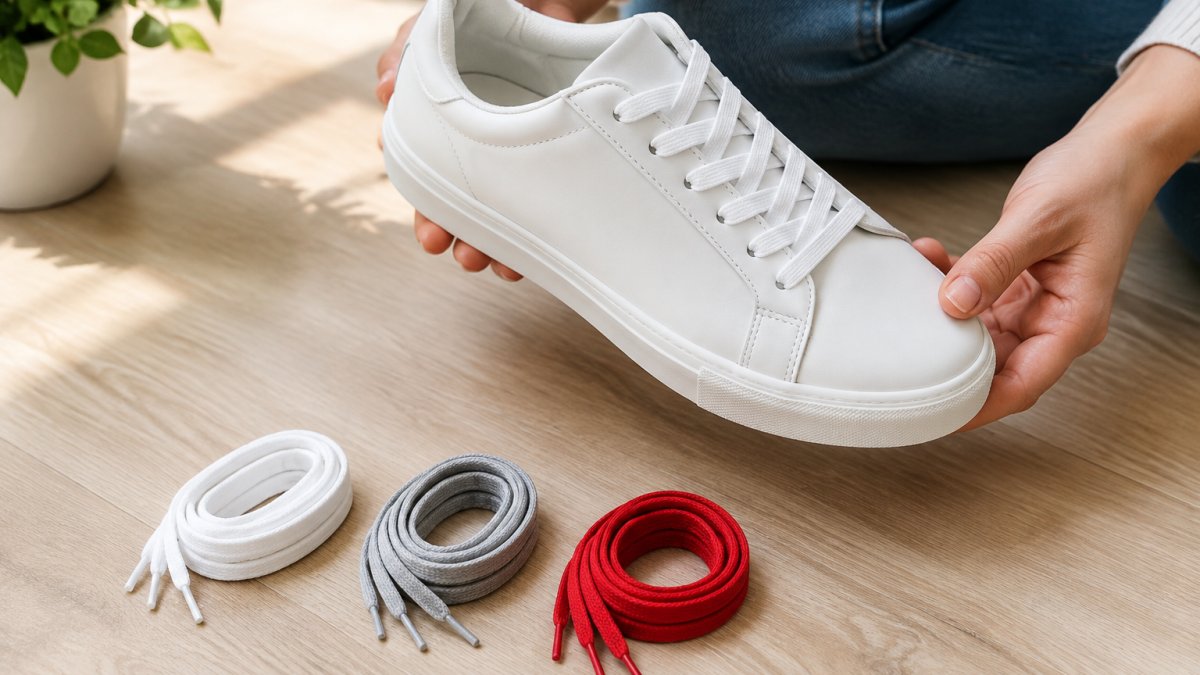
White sneakers are the most forgiving canvas you own. Almost any lace color works, which is exactly why people freeze up. Here's how we'd sort it:
- White laces: the timeless choice, and the easiest to keep looking neat
- Light grey: soft contrast, great for a tonal look
- Black: sharp and graphic, best on court-style shoes
- Scarlet red or bright blue: high contrast, best for casual outfits
- Pastels: playful, and a favorite for kids' shoes
One insider note: pure white laces on an off-white shoe can look mismatched rather than clean. If your sneakers lean cream, compare the two tones first with our white vs. off-white sneaker guide.
Sneaker Color Coordination Tips for Every Shoe Material
Material changes how a color reads. The same scarlet lace looks softer on canvas and sharper on leather, and the reason is finish, not hue.
Start with the shoe's surface, then pick a lace finish that either echoes it or deliberately contrasts it:
- Canvas: matte cotton or elastic-blend laces sit closest to the shoe's flat texture. A flat lace in a matching tone disappears into the upper; a round lace adds a subtle corded line that reads slightly darker because the curve catches shadow.
- Leather: a low-sheen waxed lace echoes the shoe's finish without competing with it. Full gloss on leather looks costume-like; a matte lace on polished leather looks underdressed. Split the difference with a semi-waxed flat lace.
- Suede: stick to muted, tonal shades in flat cotton. Bright saturated laces fight the nap because suede absorbs light while a bright lace reflects it, and the eye reads the mismatch as a color error rather than a styling choice.
- Mesh: flat, low-sheen laces keep the sporty look intact. Round laces on mesh can read as a hiking or trail cue, which is fine if that's the intent but jarring on a running shoe.
Texture matters as much as hue.
Lace construction also changes perceived color intensity. Flat laces present a broad, even face of color, so they read truest to the labeled shade.
Also check the small parts. Coordinating these subtle hardware accents creates a cohesive foundation that simplifies the broader challenge of mixing and matching clothes for a balanced everyday aesthetic.
Finally, match lace width to the shoe's scale.
Match the lace finish to the shoe's surface so the color reads the way you intend.
| Shoe material | Best lace finish | Key difference |
|---|---|---|
| Canvas | Matte cotton or elastic-blend | Flat lace disappears; round lace reads slightly darker |
| Leather | Semi-waxed flat lace | Low-sheen waxed echoes finish; full gloss looks costume-like |
| Suede | Muted, tonal flat cotton | Bright laces fight the nap and read as a color error |
| Mesh | Flat, low-sheen laces | Round laces can read as a hiking or trail cue |
No Tie Shoelaces for Kids: Color Choices That Survive Recess
For kids, darker neutrals and brighter colors are a practical pick for active days.
No tie shoelaces for kids eliminate the hassle of tying and untying, and they avoid the dangling ends of standard laces.
A few color picks that work hard for kids:
- Black or navy: hides scuffs, matches most school shoes
- Grey: neutral enough for any outfit
- Bright primaries: easy for kids to spot and love
- Pastels: soft, fun, and a hit with younger kids
Parents picking colors can browse the pastel no-tie laces for kids and match them to a favorite pair of sneakers.

Color Psychology: Formal Footwear vs. Casual Wear
Color sends a signal before you say a word, and the setting decides what that signal means. Most color guides stop at aesthetic matching; the useful layer is contextual.
Here's how the signal shifts across the settings you actually dress for:
- Office and formal settings: muted colors read as polished and controlled. Black, dark brown, grey, and deep navy say "put together." Bright laces on a dress shoe read as a mistake, not a choice, because formal dress codes reward restraint and uniformity. The mechanism is contrast: high-contrast accents draw the eye downward and break the vertical line a formal outfit is built on.
- Business casual: the rules loosen by one step. A tonal lace, grey on grey, navy on navy, keeps the polish while allowing a little personality. A single low-saturation accent, like an olive lace on a brown shoe, reads intentional without tipping into casual.
- Gym and athletic wear: function leads. Bright, high-visibility laces read as performance cues, and neon or primary colors signal energy and movement. Here contrast is an asset, not a distraction, because athletic wear is built on color blocking.
- Night out and social settings: bold laces read as confident and creative. Sneaker culture has celebrated bold color blocking for decades, and a bright lace is the cheapest way into that look. The trade-off is that bold laces date faster than neutrals and demand more deliberate outfit coordination.
- Weekend and errands: neutral laces win on effort-to-reward. They work with everything and never force a decision, which is why they dominate casual footwear.
Same color, different room, different message. A scarlet lace on a white sneaker is a statement at a ballgame and a distraction in a client meeting. Neither is wrong; the context decides.
A common pattern among stylists is to pick the lace's saturation to match the setting's formality: the more formal the room, the lower the saturation.
One more layer: color psychology is cultural and personal, not universal.
Pick Your Lace Colors and Take the Fit Quiz
Ready to commit? Here's the short version of everything above, as a checklist you can run before you buy:
- Pick your lane: shoe, outfit, or accent
- Choose neutral for formal, bold for casual
- Match lace finish to shoe material
- Check eyelet and aglet color
- Confirm the lace works in daylight, not just on a screen
Then there's fit. Color gets you close; the right lace type gets you comfort. uLace Classic laces come in White, Black, Light Grey, and Scarlet Red at $6.49 a set, and they install with a simple push-and-pull method. No tying, no dangling ends, no bending over.
One customer wrote: "I'm 72 and it's hard for me to bend over all the time to tie my shoelaces... Now I just slip my foot thru my shoes and that's it."
If you've already picked your color, you can shop white no-tie laces and get started today.

Frequently Asked Questions
Should shoelaces match the shoe or the outfit?
Both approaches work, but they create different effects. Matching laces to the shoe keeps the look clean and lets the rest of your outfit carry the color story, which is why white laces on white sneakers rarely miss. Matching laces to an outfit accent, such as a red lace on a white sneaker picked up from a red cap, ties the whole look together. Choose shoe-matching for everyday wear and accent-matching when you want the sneakers to feel intentional.
Can contrasting shoelace colors make an outfit pop?
Yes, and contrast is one of the fastest ways to add personality without buying new shoes. A scarlet red lace against a white or light grey sneaker creates a focal point at the foot that draws the eye upward through your outfit. Keep the rest of the look quieter so the contrast reads as deliberate rather than chaotic. If you already wear bold patterns or bright colors elsewhere, use a muted or tonal lace instead so the outfit stays balanced.
How do no tie shoelaces for kids change the way I style sneakers?
No tie shoelaces for kids remove the dangling, dirty lace problem and keep the shoe looking tidy all day, which makes color choice easier. Because the laces stay put, you can pick a brighter shade without worrying about it dragging on the ground or coming undone at recess. Many parents buy two colors, one neutral for school and one bold for weekends, so the same pair of sneakers works for both.
What are the best color combinations for white sneakers?
White sneakers take almost any lace color, which is why they are the easiest starting point. White on white gives a clean, monochromatic look. Light grey adds subtle depth without shouting. Scarlet red or another saturated shade creates contrast and a fashion-forward edge. For a softer look, match the lace to a color already in your outfit, like the shade of your jacket or bag, so the sneaker feels connected to what you are wearing.
Choosing a lace color is a small decision with a big visual payoff. The trick is picking a lane, respecting the setting, and then committing. uLace makes the rest easy: elastic no-tie laces in a range of colors, a secure stretchy fit, and a simple install that turns any sneaker into a slip-on. Get started with uLace and take the fit quiz to find your color and size in a couple of minutes.
