




Which Shoe Accessories Help Seniors With Joint Pain?
Last Updated: October 29, 2026
Quick Summary
Shoe accessories help seniors with chronic joint pain by removing the bending, reaching, gripping, and twisting that aggravate sore joints. No-tie laces remove knotting, long-handled shoehorns remove reaching to the heel, and sock aids reduce grip strain. Choose the accessory that targets the motion hurting you most.
- No-tie laces remove the need to bend down and tie knots.
- Long-handled shoehorns let you slide shoes on without bending at the hips or knees.
- Sock aids hold a sock open so you can avoid pinching and pulling fabric.
- Test a new accessory while seated to confirm it does not force you to lean or twist.
- Accessories ease daily dressing but do not treat arthritis or reverse joint damage.
Table of Contents
- Why Shoe Accessories Matter for Seniors With Chronic Joint Pain
- No-Tie Shoelaces for Seniors Who Struggle to Bend
- Long-Handled Shoehorns for Seniors Who Cannot Reach Their Heels
- Sock Aids for Arthritis: Getting Socks On Without Strain
- Choosing Walking Shoes for Arthritis: What Matters Most
- Comparing uLace Options by Need and Budget
- Booking Your Next Step: Trying uLace for Easier Daily Dressing
- Frequently Asked Questions
Seniors living with chronic joint pain often find that the hardest part of getting dressed is not the shirt or the pants but the shoes. Bending down, gripping a lace, and pulling a heel into place can aggravate sore hips, knees, and hands. This guide from uLace looks at the accessories that can make that daily routine easier, and at how to choose among them.
The right accessory depends on the problem you are solving. A no-tie lace removes the bending and knotting. A long-handled shoehorn removes the reaching. A sock aid removes the strain of pulling a sock over stiff fingers. Each one targets a different point of friction, so it helps to start with the task that hurts most.
Research on footwear for older adults supports paying attention to fit and support (Enhancing Footwear Safety for Fall Prevention in Older Adults). A systematic review of footwear and inserts for lower-extremity joint pain and mobility in older adults examined how shoe inserts and footwear affect joint pain, gait, and mobility in this group.
Why Shoe Accessories Matter for Seniors With Chronic Joint Pain
Shoe accessories matter because they remove the specific movements that aggravate chronic joint pain, bending, reaching, gripping, and twisting, rather than asking the wearer to push through those movements. Most of the strain in putting on shoes comes from the body mechanics around the shoe, not from the shoe itself. A small tool can eliminate a motion that would otherwise trigger pain or cause a fall.
The right accessory depends on which joint is talking. A useful way to sort the market is by the motion each accessory removes:
- Hips and lower back: bending forward to tie or reach the heel. Long-handled shoehorns and no-tie laces remove most of this motion.
- Knees: kneeling or lifting a foot high to pull on a shoe. A long-handled shoehorn plus a seated dressing routine keeps the knee from bearing weight in a bent, twisted position.
- Hands and wrists (often arthritis): gripping laces, pinching knots, and pulling fabric. No-tie laces, elastic lock laces, and sock aids reduce grip force.
- Ankles and feet: pressure from tight closures and hard heel counters. Cushioned insoles, heel cups, and wider or adjustable closures address this without changing the shoe.
Accessories also protect independence. A senior who can dress without waiting for help keeps control over the morning and avoids the rushed, off-balance movements that happen when someone else is helping. That matters as much as comfort.
A practical way to choose is to note which movement hurts most over three or four days: bending to tie, reaching the heel, or gripping a sock. Then buy the one accessory that removes that motion before adding others. Layering several aids at once makes it harder to tell what is helping and increases the chance of a poor fit.
One caution that applies across all accessories: they are comfort and independence tools, not treatments. They can reduce the effort of daily dressing and may ease pressure on sore joints, but they do not treat arthritis or reverse joint damage. If pain is new, worsening, or accompanied by swelling, redness, or loss of balance, see a clinician before relying on any accessory.
No-Tie Shoelaces for Seniors Who Struggle to Bend
No-tie shoelaces replace the knot with an elastic lace that stretches over the foot. The wearer slips the shoe on without touching a bow, which removes the need to bend down and work at the laces.
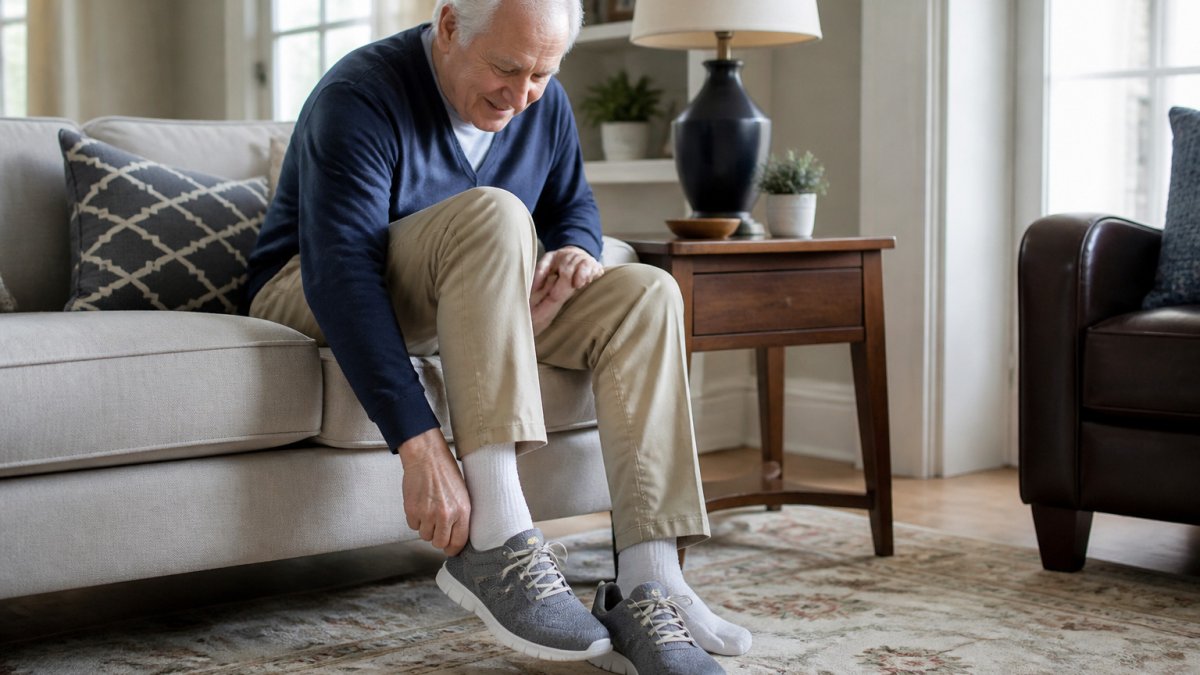
One uLace customer, age 72, described the difficulty directly: "It's hard for me to bend over all the time to tie my shoelaces... Now I just slip my foot thru my shoes and that's it." That experience reflects the main benefit of no-tie laces: less bending and less fiddling with knots. Eliminating the need for constant adjustment provides immediate relief, though pairing these laces with appropriate shoes for foot pain can further stabilize the joints during daily movement.
The uLace Shorts in black are priced at $12.99. browse the uLace Shorts - Black to see the current design.

Before buying, measure your shoe's lacing area and check whether the lace width suits the eyelets. A lace that is too loose will slide, and one that is too tight will press on sore joints.
Long-Handled Shoehorns for Seniors Who Cannot Reach Their Heels
A long-handled shoehorn lets the wearer slide a shoe onto the foot without bending at the hips or knees. The curved horn guides the heel into the shoe, and the long handle keeps the hands at a safe distance from the floor.
This tool suits anyone whose reach is limited by back, hip, or knee pain. It also helps when the heel of the shoe is firm and resists pushing in by hand.
To use one, sit down, place the horn inside the heel, and press the shoe forward with a steady motion. Keep the heel of the shoe seated before standing up.
Sock Aids for Arthritis: Getting Socks On Without Strain
Sock aids are frames or loops that hold a sock open so the wearer can slide the foot in without gripping fabric. They target the hand and wrist strain that makes socks harder than shoes for many people with arthritis: pinching a sock cuff, bunching it over the toes, and pulling it up the calf all require sustained grip and dexterity.
There are two common designs, and the choice should follow hand strength and reach:
- Rigid frame aids hold the sock open on a plastic or coated-wire frame with two long handles. They work well for people with moderate grip strength who can pull two handles apart and down. The trade-off is bulk, they take up drawer space and can be harder to store.
- Flexible loop or strap aids use a softer loop and a single strap or handle. They are lighter and easier to pack for travel, but they demand a bit more control to keep the sock from twisting.
Match the aid to the sock, not just the hand. Thin dress socks and compression socks behave very differently on the same frame. A frame sized for a thick athletic sock will let a thin sock slip off before the foot is in; a frame too small for a compression sock will bunch it at the heel.
A safe routine, done seated:
- Sit on a stable chair and bring the foot up so the ankle rests near the opposite knee, or use a footstool if hip or knee pain makes that difficult.
- Load the sock onto the aid with the heel pocket facing the correct direction, this is the step most people get wrong and the reason socks end up twisted.
- Slide the foot in to the heel, then pull the aid away by the handles rather than yanking the sock.
- Smooth the sock up the calf by hand only if grip allows; otherwise use a second, gentler pull with the aid.
Cost and upkeep are modest but worth planning for. Replace an aid when the handles crack, the coating peels, or the loop stretches enough that the sock no longer stays open.
Sock aids pair naturally with no-tie laces and a long-handled shoehorn: the sock aid handles the sock, the shoehorn handles the heel, and the lace removes the knot. Together they cover the full dressing routine without requiring a deep bend or a tight grip.
Choosing Walking Shoes for Arthritis: What Matters Most
Walking shoes for arthritis should fit well before they add features. Look for enough room in the toe box, a secure closure that does not press on swollen areas, and soft uppers that will not rub.
Watch out: a shoe that feels comfortable in the store can still press on a swollen foot after a full day. Try shoes late in the day, when feet are most swollen.
Comparing uLace Options by Need and Budget
uLace offers several no-tie laces at different price points, so the choice can follow your needs and budget.
| Product | Price (USD) | Notes |
|---|---|---|
| uLace Slims - Black | $5.99 | Slim profile, black |
| uLace Slims - Canvas / Off-White | $5.99 | Neutral tone |
| uLace Slims - Rainbow | $5.99 | Colored option |
| uLace Classic - Black | $6.49 | Standard width, black |
| uLace Shorts - Black | $12.99 | Shorter lace length |
| uLace ProFormance - Black | $14.99 | Performance-oriented model |
If budget is the main concern, the Slims and Classic models cost the least. The ProFormance model is the higher-priced option in this range, and it may suit wearers who want a performance-oriented lace. Compare the uLace ProFormance - Performance No-tie Laces - Black to see how it is built.

Booking Your Next Step: Trying uLace for Easier Daily Dressing
Start with the task that causes the most strain. If bending is the problem, a no-tie lace may remove the hardest part of the routine. If reaching is the problem, a long-handled shoehorn may do more.
uLace has been in business since 2009 and stands behind its products with its guarantee. If you want to see what a no-tie lace looks like on your own shoes, browse the uLace Classic - Black and compare the options side by side.

Frequently Asked Questions
Are no-tie shoelaces helpful for seniors with joint pain?
No-tie laces remove the repeated bending and pulling that tying requires, which is often the hardest part of putting on shoes for someone with arthritis in the hands, knees or back. uLace elastic laces let the wearer slip a foot in and out after a one-time setup, and the brand notes they avoid dangling, dirty shoestrings. A customer who is 72 wrote that bending to tie laces was hard for her, and that she now just slips her foot through her shoes. Laces do not replace a properly fitted shoe, so check that the shoe fits before adding accessories.
What is the best shoehorn for someone who has trouble bending?
A long-handled shoehorn lets the wearer guide the heel of a shoe without bending the spine or reaching down to the heel. Look for a handle long enough to keep the hand at a comfortable height and a smooth, curved horn that will not catch on the heel counter. The research supplied for this article does not compare specific shoehorn models, so choose based on handle length, sturdiness and how easily you can grip it. Test it while seated before relying on it every day.
Do sock aids help people with limited mobility?
A sock aid is a frame or loop that holds a sock open so the wearer can slide a foot in without bending to pull the sock over the toes and heel. This can reduce strain on the hands, wrists and lower back for people with arthritis. The supplied research does not measure how much a sock aid reduces effort, so treat it as a practical tool to test rather than a guaranteed fix. Practice at a stable chair and keep the aid within easy reach.
What features should seniors look for in walking shoes for arthritis?
Arthritis footwear guidance points to adjustable closures, such as laces or buckles, and soft uppers that accommodate painful or swollen feet. Properly fitted shoes with moderately firm insoles and slip-resistant outsoles are also recommended for mobility and fall prevention. Straps should not press on tender areas. A shoe that is easy to slip on, with room for swelling, usually works better than a tight, fixed-lace shoe. Talk with a podiatrist or physical therapist before making major footwear changes.
