




Are Elastic Laces Worth the Price? A 2026 Review
Table of Contents
- The Real Cost of Elastic Laces vs. Traditional Shoelaces
- Benefits of No-Tie Shoelaces: More Than Just Convenience
- How to Lace Shoes Without Tying: A Step-by-Step Guide
- Durability of Elastic Shoelaces: How Long Do They Really Last?
- uLace Product Line Review: Which Option Fits Your Needs?
- Are Elastic Laces Worth the Price for Your Lifestyle?
- Frequently Asked Questions
Last Updated: September 16, 2026
The Real Cost of Elastic Laces vs. Traditional Shoelaces
A pair of traditional cotton shoelaces costs a few dollars and lasts roughly six months of daily wear. Elastic no-tie laces cost a few dollars more up front and can last years. That math is the entire case for switching, and it's why so many people searching for whether elastic laces are worth the price end up surprised by how quickly the savings add up.
footwear construction and materials reference
Benefits of No-Tie Shoelaces: More Than Just Convenience
The headline benefit of no-tie shoelaces is convenience, but that undersells what they actually change about daily shoe wear. A slip-on fit removes the bend-and-tie motion entirely, which matters enormously for anyone with limited mobility, arthritis, or fine motor challenges.
- Consistent tension adjustment. The lace stretches with your foot, so snugness stays even as your feet swell during the day.
- No dangling ends. Nothing drags on the ground, so laces stay cleaner and you stop tripping over them.
- Protection for the shoe itself. People who force their feet into tied sneakers stretch the heel collar and break down the shoe's structure. Slip-on laces remove that habit.
How to Lace Shoes Without Tying: A Step-by-Step Guide
Lacing shoes without tying takes about five minutes per pair and requires no tools. The method is a simple push-and-pull installation that threads each elastic segment through the eyelets. The steps are the same whether you're converting running shoes, casual sneakers, or a pair of dress shoes with standard eyelets, but the eyelet configuration changes how you route the segments, and that's where most first-timers go wrong.
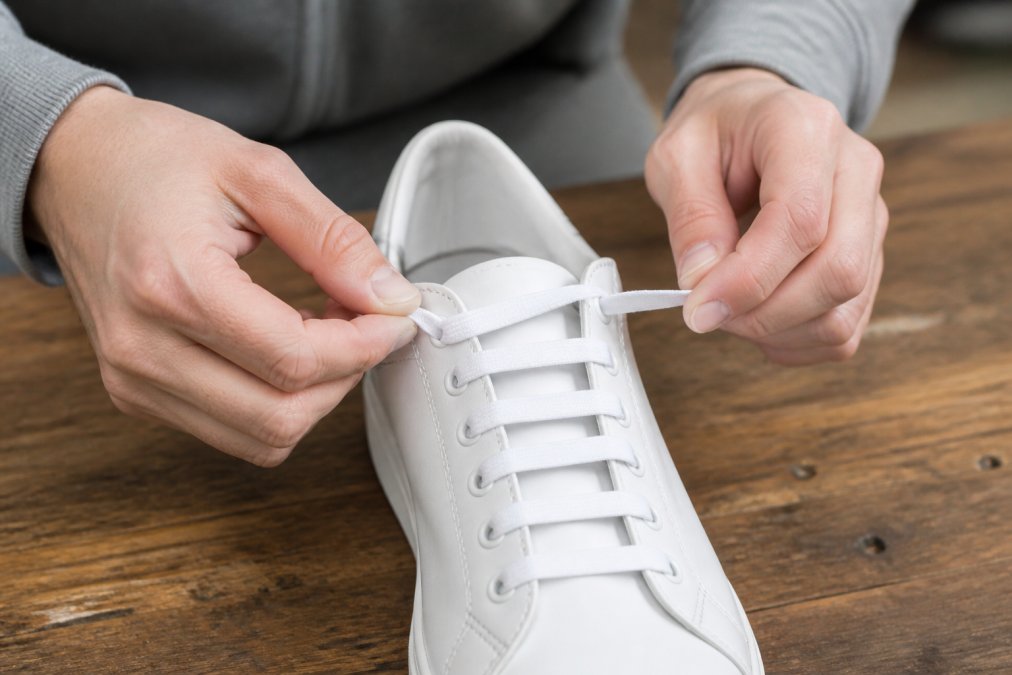
The basic installation
- Remove the existing laces and set them aside.
- Start at the bottom eyelet and thread the first elastic segment through.
- Work upward, matching the eyelet configuration of your shoe.
- Adjust each segment so tension is even across the whole lace.
- Pull the final segment through the top eyelet to lock the fit.
- Slide your foot in and fine-tune the snugness.
Expected result: The shoe slips on and off without untying, and the lace holds a secure fit through walking and light activity.
Match the routing to your eyelet type
Not every shoe takes the same pattern. A quick compatibility guide:
- Standard 5-7 eyelet sneakers (running, casual, skate): Use the full-length segment set. Route straight across the top two eyelets for a cleaner look, or criss-cross for a more locked-in feel.
- Low-profile shoes with 3-4 eyelets (slip-ons, minimalist trainers): Use short segments. Full-length laces bunch at the top and create pressure points.
- Dress shoes and oxfords with small, close-set eyelets: Use slim-profile laces. Standard-width elastic can be too thick to pass cleanly and will fray against the eyelet edge.
- Trail runners and hiking shoes with reinforced eyelets: Use a performance-grade lace with a thicker core. The reinforced eyelet edge is abrasive, and thin elastic wears through faster there than anywhere else on the shoe.
- Boots with speed hooks: Elastic laces are a poor fit. Speed hooks are designed for quick tension release, which defeats the point of a set-and-forget lace.
Tension troubleshooting
The one mistake to avoid is pulling the segments too tight on the first pass. Elastic laces settle after a day of wear, so a slightly looser initial fit usually ends up perfect. If you over-tighten on day one, you'll feel pressure across the top of the foot by mid-afternoon.
Other common issues and fixes:
- Lace feels loose after a few hours: Re-seat the top segment. The lock point, not the whole lace, controls most of the tension.
- Pressure point on the instep: Loosen the second-from-top segment. That's the segment that carries the most load when you walk.
- Lace slips through the top eyelet: The segment is too short for that eyelet spacing. Move up one size or switch to a longer set.
- Uneven tension left vs. right: Adjust each side independently. Feet are rarely symmetrical, and matching tension to each foot beats matching it to the other shoe.
Re-lacing and re-use
Elastic laces are removable. If you sell the shoes, want to switch back to traditional laces, or move the set to a new pair, the segments pull out the same way they went in. That reusability is part of the cost case: one set can outlast two or three pairs of shoes if you keep the same eyelet count.
footwear construction and materials reference
Durability of Elastic Shoelaces: How Long Do They Really Last?
Elastic shoelaces typically last far longer than cotton laces because they don't fray at the eyelets the way woven cotton does. The elastic core resists the abrasion that kills traditional laces, and the locking mechanism holds tension without loosening. But "elastic" is a category, not a material, and the durability gap between a well-made set and a bargain set is wider than the gap between elastic and cotton.
The material science, briefly
Most no-tie laces fall into two families, and they age differently:
- Bungee-style (round, cord-like) laces. A rubber or silicone core wrapped in a woven sheath. The core provides the stretch; the sheath provides the abrasion resistance. When a bungee lace fails, it usually fails at the sheath first, the weave rubs through at the eyelet, exposing the core, which then snaps. Tension stays consistent until the sheath goes, then drops off a cliff.
- Flat-elastic laces. A flat woven band with elastic threads running through it. These distribute pressure more evenly across the top of the foot and look more like traditional laces. They tend to lose rebound gradually rather than failing suddenly, the lace gets progressively slacker over months rather than breaking.
What actually kills an elastic lace
Three failure modes account for most replacements:
- Eyelet abrasion. The lace rubs against the eyelet edge every time you put the shoe on and take it off. Metal eyelets with a sharp inner edge are the worst offenders; plastic or rolled eyelets are gentler. This is the single biggest factor in lifespan.
- UV and heat exposure. Elastic polymers degrade with prolonged sun and heat. Laces left in a hot car or worn for outdoor sports in direct sun lose rebound faster than laces kept indoors.
- Over-stretching. Pulling the lace past its elastic limit, usually by forcing a foot into a too-tight shoe, permanently deforms the core. Once stretched past the limit, the lace never returns to its original tension.
How to tell quality from bargain
A few physical checks before you buy:
- Stretch and release. A quality elastic snaps back to its original length immediately. A cheap one stays slightly stretched.
- Sheath density. Run a fingernail along the weave. Tight, dense weave resists abrasion; loose weave exposes the core.
- Core thickness. Thicker cores hold tension longer but feel stiffer underfoot. Thinner cores feel softer but lose rebound faster.
- End hardware. Crimped metal ends or molded plastic tips hold up better than glued or knotted ends, which are the first thing to fail on budget laces.
A common mistake is buying the cheapest elastic laces available and judging the whole category by them. A quality elastic core keeps its snap for years, while a bargain version can go slack in months. That's the real difference between a $5 pair and a $15 pair, not the stretch, but how long the stretch lasts.
Realistic lifespan expectations
There's no universal number, but a common pattern reported by long-term users:
- Casual daily wear, quality flat-elastic: one to three years before noticeable slack.
- Running or sport, quality bungee: six months to a year of regular training before the sheath shows wear.
- Bargain elastic, any use: weeks to a few months before tension loss.
- Cotton laces, for comparison: roughly six months of daily wear before fraying at the eyelets.
materials durability and testing standards
uLace Product Line Review: Which Option Fits Your Needs?
uLace has made no-tie elastic shoelaces since 2009, and the range covers everything from everyday sneakers to performance gear. The line splits into distinct options, so picking the right one comes down to your shoe type and how you use it.
| Product | Price | Best For | Style |
|---|---|---|---|
| uLace Classic - Black | $6.49 | Everyday sneakers | Classic flat |
| uLace ProFormance - Black | $14.99 | Running and sports | Performance |
| uLace Shorts - Black | $12.99 | Low-profile shoes | Short segments |
| U-Lace Siliprint - America | $12.99 | Statement style | Patriotic print |
| uLace Slims - Rainbow | $5.99 | Slim eyelets, color | Slim profile |
Are Elastic Laces Worth the Price for Your Lifestyle?
Elastic laces are worth the price if you wear your sneakers daily, struggle with bending or tying, or want a slip-on fit without giving up the shoes you love. The cost-effectiveness shows up over time: one purchase replaces the repeated cycle of buying and re-threading traditional laces. This shift toward long-term utility mirrors the broader debate regarding the worth of expensive clothing when evaluating whether premium materials truly justify their initial investment.

The case is strongest for a few groups:
- Seniors and people with arthritis who find bending and tying difficult.
- Parents who want kids to manage their own shoes.
- Frequent travelers who want slip-on convenience at security lines and hotel rooms.
- Sneaker enthusiasts who want customization and a tidy look.
consumer product safety and footwear guidance
Frequently Asked Questions
Are elastic laces worth the price for everyday walking?
For daily wear, elastic laces like uLace Classic at $6.49 offer strong value. They eliminate re-tying, reduce lace pressure, and keep sneakers snug. If you walk frequently or have mobility issues, the convenience and comfort quickly justify the cost. Many users find they last as long as traditional laces, making them a practical upgrade for casual footwear.
Do elastic shoelaces lose their tension over time?
Quality elastic laces are designed to maintain tension through repeated use. The durability of elastic shoelaces depends on material and construction. uLace products use stretchy yet resilient materials that hold their shape. Over months of daily wear, some stretch is normal, but proper installation and tension adjustment keep them secure. Replace if you notice significant slack or fraying.
Can you use elastic laces on any type of sneaker?
Most sneakers work with elastic laces, but eyelet configuration matters. uLace offers styles like Classic, Shorts, and Slims to fit different shoe types. For wide feet or tight shoes, the stretch helps with slip-on fit. Check the product guide to match lace style with your sneaker's design.
Are no-tie laces secure enough for high-intensity sports?
Yes, performance-focused options like uLace ProFormance are designed for athletic use. They provide a secure fit with customizable tension, so they stay put during running or court sports. The locking mechanism and elastic core keep foot compression consistent. They offer quick-release convenience without sacrificing stability.
How do elastic laces compare to traditional laces for foot comfort?
Elastic laces distribute lace pressure more evenly, reducing hot spots and foot compression. They accommodate foot swelling during activity, which traditional laces cannot. For people with arthritis or fine motor challenges, they remove the need for re-tying. The snugness is adjustable, so you get a secure fit without pinching. Many users report less fatigue after long wear.
Elastic laces come down to a simple trade: a small upfront cost in exchange for years of slip-on convenience. If bending to tie laces is a daily annoyance or a genuine barrier, that trade pays off fast. uLace makes the switch easy with a simple push-and-pull installation, a range of styles and colors, and a secure stretchy fit that holds all day. Get started with uLace and turn the sneakers you already love into hassle-free slip-ons.