




How to Keep Laces Tied: 7 Proven Fixes That Work
Table of Contents
- Why Shoelaces Come Untied (It's Not Just You)
- How to Tie a Double Knot That Actually Holds
- Ian's Secure Shoelace Knot Tutorial: Step by Step
- Best No-Tie Shoelace Systems for a Secure Fit
- Tension, Lacing Patterns, and Fit Adjustments
- Troubleshooting Laces That Still Come Loose
- Frequently Asked Questions
Last Updated: September 15, 2026
Why Shoelaces Come Untied (It's Not Just You)
If you want to know how to keep laces tied, the answer starts with physics, not willpower. A standard bow knot is a temporary structure held together by friction alone, and friction decays with every step you take (The roles of impact and inertia in the failure of a shoelace knot).
This guide from uLace covers the mechanics behind knot failure, the tying methods that resist it, and the no-tie systems that remove the problem entirely. The double-knot technique most people learned as children is only the beginning.
Here's the part most guides skip: your laces aren't defective, and you're not tying them wrong in some mysterious way. The knot itself is designed to release under repeated shock. Understanding that changes how you fix it.
The Knot Mechanics Behind Slippage
A bow knot is two opposing forces in a tug-of-war. The starter knot creates the base tension, the loop-and-swoop forms the bow, and friction between the laces holds the whole assembly together.
Every footfall sends a shockwave through that structure. The knot loosens a fraction of a millimeter per step, and the tail ends whip side to side, which pulls the loops tighter and pushes the free ends out. Once the free ends are long enough and light enough, they swing free and the knot unwinds.
This is why a knot that holds on a walk fails on a run. More impact cycles per minute means faster friction decay.
Lace Material and Knot Security
Lace material decides how much friction your knot has to work with. Cotton laces have a rough, textured surface that grips well, but they stretch over time and lose tension. Synthetic fibers like polyester and nylon are smoother, which means less friction and a greater tendency to slip.
Round laces slip more than flat laces because the contact area between strands is smaller (The West Point Knot: A Sliding-Locking Arthroscopic Knot). Waxed laces solve this temporarily by adding surface grip, but the wax wears off. Elastic laces behave differently again: they stretch under load, so the knot has to hold against continuous tension rather than static tension.
That's the trade-off nobody mentions. A material that feels soft and comfortable often has the worst knot integrity.
How to Tie a Double Knot That Actually Holds
The double knot is the fastest fix for slippage, and it works by adding a second mechanical lock on top of the first. Most people tie it wrong, though, which is why it still comes loose.
Here's the sequence that holds:
- Cross the laces and pull them taut to form the starter knot.
- Make a loop with one lace and wrap the other around it once.
- Pull that loop through to form your standard bow.
- Take both loops and pass one through the hole at the base of the bow.
- Pull both loops outward until the knot seats firmly.
The critical step is number five. A double knot that isn't pulled tight just adds a loose layer that works itself free faster than a single bow would.
Why the Double Knot Fails Anyway
A double knot adds friction surface, but it doesn't change the underlying mechanics. The starter knot still carries the load, and every footfall still sends a shockwave through it. What the second lock does is slow the rate at which the free ends can whip and unwind the bow.
That's why a double knot holds on a walk and still fails on a long run. The extra lock buys time, not immunity. If your tails are short, the whipping motion has less leverage, so the knot survives longer. If your tails are long and light, the second lock just delays the inevitable.
How Lace Material Changes the Math
Cotton and cotton-blend laces have a rough, textured surface that grips well, so a double knot on cotton can hold for hours of walking. Polyester and nylon are smoother, which means less friction per contact point, so the same knot on the same shoe can fail in under an hour of running (pubmed.ncbi.nlm.nih.gov).
Round laces slip more than flat laces because the contact area between strands is smaller. Waxed laces add temporary surface grip, but the wax wears off after a few wears and the knot returns to its baseline behavior. Elastic laces stretch under load, so the knot has to hold against continuous tension rather than static tension, a different problem that a double knot only partly solves.
How to Tell If Your Double Knot Is Seated
A properly seated double knot has three visible signs:
- The bow sits flat against the tongue with no gap underneath.
- Both loops are roughly the same size and lie parallel, not crossed.
- The tails hang straight down, not kicked out to the side.
If you see a gap under the bow, the knot isn't seated and it will fail within the hour. If the loops are crossed, the second lock is misaligned and adds less friction than it should. If the tails kick out, they're catching air and whipping, which is the exact motion that unwinds the knot.
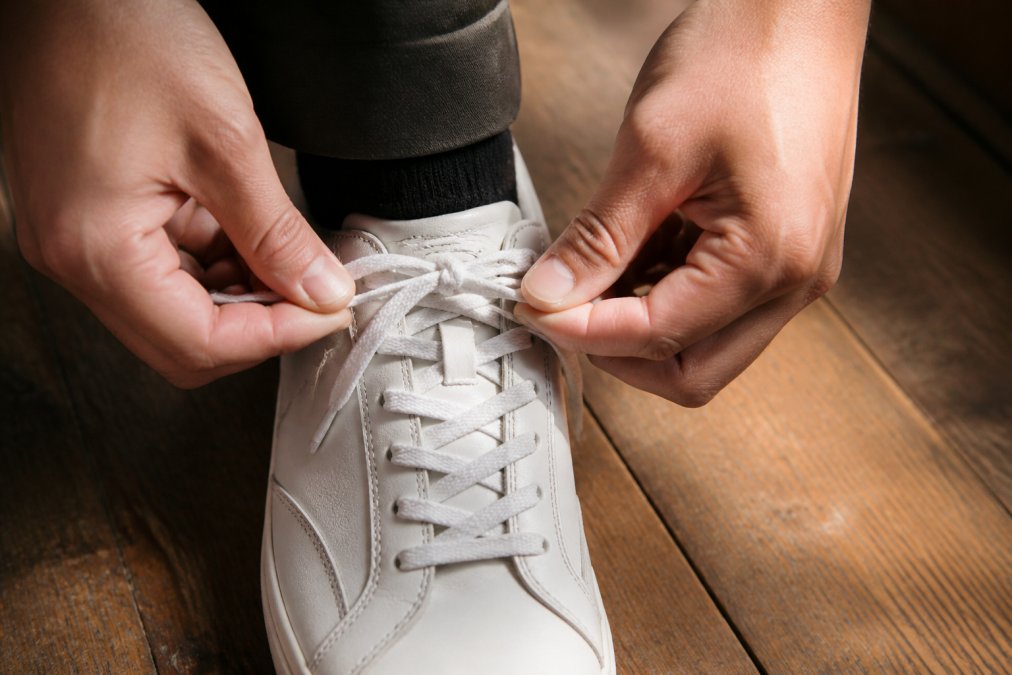
Ian's Secure Shoelace Knot Tutorial: Step by Step
Ian's secure shoelace knot is a variation that replaces the weak first crossing with a doubled one, which is why it resists slippage far better than a standard bow. The method is sometimes called the Ian knot, and it takes about ten seconds once you've practiced it.
- Form a loop in each lace and hold one in each hand.
- Cross the right loop over the left loop.
- Thread the right loop under and through the gap between the two laces.
- Pull both loops outward to tighten.
- Tug each tail separately to seat the knot.
- Check that both loops sit flat against the shoe.
What makes this knot different is the direction of the first crossing. A standard bow crosses the laces one way; Ian's crosses them the opposite way, which aligns the strands so friction works with the tightening motion instead of against it.
For runners, this is the single highest-value change you can make without buying anything. Pair it with flat laces rather than round ones and knot failure becomes rare.
Best No-Tie Shoelace Systems for a Secure Fit
No-tie shoelace systems replace the knot entirely, which is the only permanent solution to slippage. Instead of relying on friction between two strands, they use elastic tension and a fixed anchor to hold the shoe in place.
uLace is the original creator of no-tie elastic shoelaces, and the system works differently from most elastic options. Each lace is installed through the eyelets with a simple push and pull method, then trimmed to length, so there's no knot to fail and no dangling ends to trip on. The elastic holds steady tension across the top of the foot all day.
The practical difference shows up in three places:
| System type | How it holds | Best for | Main drawback |
|---|---|---|---|
| Standard bow | Friction between strands | Casual wear, short trips | Loosens with every step |
| Double or Ian's knot | Added mechanical lock | Running, hiking | Still requires tying |
| Elastic no-tie laces | Continuous elastic tension | Kids, seniors, daily wear | Needs correct sizing |
For parents, the Kiddos line turns any pair of kids' sneakers into slip-ons, which removes the morning tying battle entirely.
Tension, Lacing Patterns, and Fit Adjustments
Troubleshooting Laces That Still Come Loose
A Diagnostic Decision Tree
Visual Troubleshooting: What the Knot Tells You
When to Stop Troubleshooting and Switch Systems
Frequently Asked Questions
How do I stop my shoelaces from untying?
Start with a secure base: cross the laces, tuck one under, and pull taut. Then add a double knot by passing each loop through the second time. This adds friction so the knot resists vibration. If laces still slip, check the material: cotton holds better than slick synthetic fibers. For a permanent fix, switch to elastic no-tie laces like uLace, which stay set without any knot.
What is the most secure knot for athletic shoes?
The Ian's Secure Shoelace Knot is widely considered the most secure for running and sports. It uses a double-loop structure that locks under tension and releases with a single pull. Pair it with flat, slightly textured laces, and re-tie before every run. If you want zero tying, a no-tie system such as uLace ProFormance provides a stretchy, locked fit that holds through sprints and cuts.
How to keep laces tight without tying?
Use elastic no-tie laces. Thread them through the eyelets, adjust the tension once, and lock them with the included clip or by tucking the ends. uLace Classic ($6.49) turns any sneaker into a slip-on and keeps a snug fit all day. This works well for kids, seniors, and anyone with fine motor challenges who cannot tie traditional knots.
Are there permanent solutions for loose shoelaces?
Yes. Replace standard laces with elastic no-tie systems. uLace has offered these since 2009 and makes them in styles for kids (uLace Kiddos, $5.99), everyday wear (uLace Classic, $6.49), and performance (uLace ProFormance, $14.99). They eliminate the knot entirely and hold tension through walking, running, and hiking. Installation takes a minute with a simple push-and-pull method.