




Best No-Tie Shoelaces for Marathon Runners in 2026
Last Updated: October 22, 2026
Quick Summary
The best no-tie shoelaces for marathon runners are uLace ProFormance, which cost $14.99 per set and come in eight colors. They hold a secure fit for 26.2 miles, let you adjust tension as your feet swell, and install with a simple push-and-pull setup.
- We judged elastic laces on lace security, adjustable fit, elasticity, installation, and durability, with price and color last.
- Lacing a shoe without tying takes about five minutes: thread the elastic lace, set tension once, and lock it.
- Most runners' feet expand about half a shoe size over a long effort, so set tension for mile 20.
- Use heel-lock lacing to stop heel slip instead of overtightening the bottom eyelets.
- Install a fresh set at least two to three weeks before race day and carry a spare in your race bag.
Table of Contents
- Why Marathon Runners Are Switching to No-Tie Shoelaces
- How We Evaluated the Best Elastic Shoelaces for Running
- 1. uLace ProFormance: The Best No-Tie Shoelaces for Marathon Runners
- How to Lace Running Shoes Without Tying: Step-by-Step Setup
- Marathon Running Shoe Lacing Techniques for Long-Distance Comfort
- Fit, Tension, and Foot Swelling: Getting the Adjustment Right
- Durability, Replacement, and Race-Day Practicalities
- Conclusion: Choosing the Right No-Tie Laces for Your Race
- Frequently Asked Questions
Why Marathon Runners Are Switching to No-Tie Shoelaces
No-tie shoelaces are elastic lace systems that turn a running shoe into a slip-on, holding the foot with steady stretch instead of a knot.
A Journal of Athletic Training study indexed in PubMed compared laced conditions on perceived comfort, plantar pressure, and rearfoot motion.
Below, we break down what actually matters for a marathon, how to set up no-tie laces correctly, and which laces we recommend for race day.
How We Evaluated the Best Elastic Shoelaces for Running
We judged elastic laces on five criteria a marathon runner can measure: lace security over long distances, adjustable fit and tension, elasticity that returns after stretching, ease of installation, and durability across repeated wear. Price and color came last, because a lace that fails at mile 20 is expensive at any price.
Our picks come from published gear coverage, manufacturer specifications, and the practical setup questions runners send us. Runner's World's 2026 roundup of elastic shoelaces names different laces for different runners rather than crowning one universal winner, and that matches what we see: the right lace depends on your shoe, your foot shape, and how much stretch you want.
| Criterion | What We Check | Why It Matters in a Marathon |
|---|---|---|
| Lace security | Holds tension without slipping | Loose laces mean heel slip and hot spots |
| Adjustable fit | Can be tightened or loosened without retying | Feet swell over 26.2 miles |
| Elasticity | Returns to shape after stretch | Sagging laces lose lockdown |
| Installation | Setup time and tools required | Race week is not the time for a project |
| Durability | Wear across repeated use | One set should cover a full training block |
1. uLace ProFormance: The Best No-Tie Shoelaces for Marathon Runners
Our top pick for marathon runners is uLace ProFormance, a performance no-tie lace sold in eight colors at $14.99 per set. A simple push-and-pull installation means you thread once and never tie again, so race-morning shoe changes take seconds and nothing dangles near your ankle.

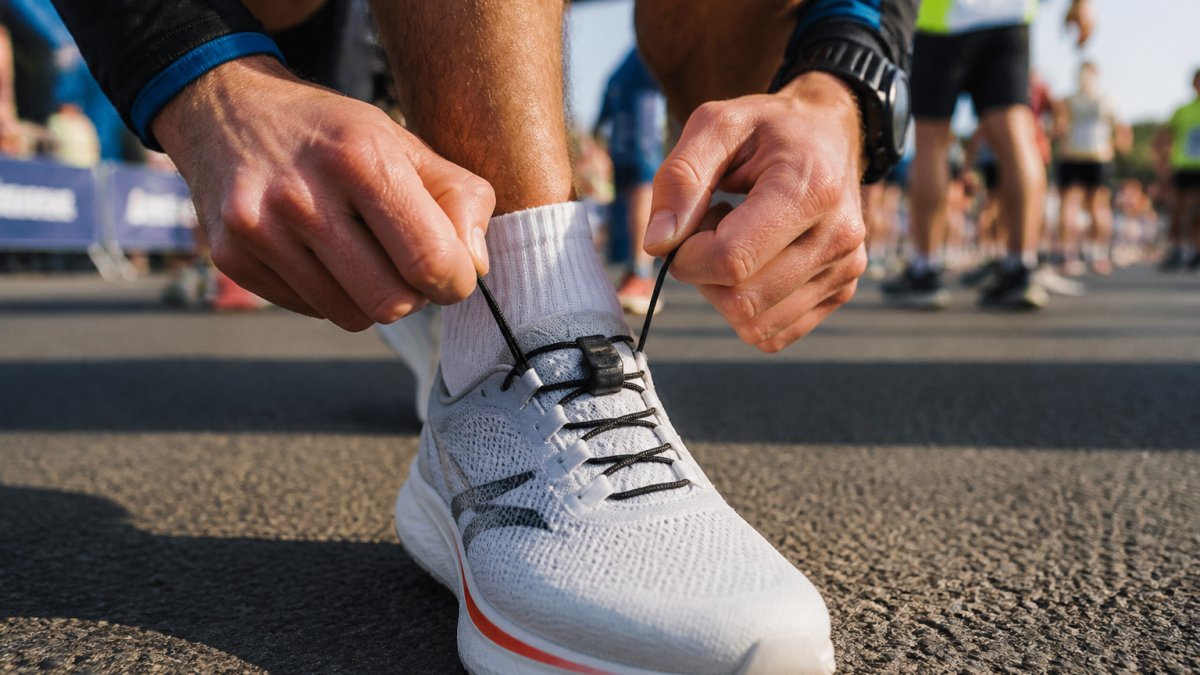
The stretch matters most over distance. Steady elasticity keeps pressure even across the top of the foot when your feet swell late in a race, and you can ease tension without undoing anything, a two-second action instead of a stop.
Pros and Cons
What works: the elastic holds a secure fit while staying easy to slip on and off, the lace ends stay tucked rather than swinging, installation is simple, and the color range covers neutral shoes as well as bright race-day setups.
What does not: like any elastic lace, it may not suit a runner who wants a completely rigid, custom-tensioned fit at every eyelet.
Pricing and Color Options
A set costs $14.99, which covers one pair of shoes. Colors include Black, White, Royal Blue, Scarlet Red, Bright Green, Neon Orange, Neon Yellow, and Light Navy Blue. Black and white handle most trainers and racers; the neons are for runners who want the shoe to read fast.


How to Lace Running Shoes Without Tying: Step-by-Step Setup
Lacing a running shoe without tying takes about five minutes: remove the old laces, thread the elastic lace through the eyelets in your normal pattern, then set tension once and lock it. The goal is a slip-on fit that holds without a knot.
- Pull out the original laces and clear the eyelets.
- Thread the elastic lace from the bottom eyelet upward, alternating sides as you would with standard laces.
- Leave the lower section slightly looser than the top, so your forefoot has room.
- Pull the lace ends until the shoe hugs the midfoot without pinching.
- Secure the ends using the lace's own locking method, following the instructions included with the set.
- Slide your foot in and out twice. If entry is tight, ease the top section; if your heel lifts, tighten the midfoot.
- Run a short easy session before a long run to confirm the tension holds.
Marathon Running Shoe Lacing Techniques for Long-Distance Comfort
Marathon shoe lacing should hold the heel down, keep pressure off the top of the foot, and leave room for swelling.
Heel-lock lacing. REI's guide to lacing running shoes describes the Runner's Loop, a technique that creates a secure loop at the top eyelet to hold the heel in place and help stop toes sliding forward.
Two-zone tension. Set the lower half slightly relaxed and the upper half firmer. Your forefoot needs room to spread at push-off, while your midfoot and heel need to stay put.
uLace ProFormance - Performance No-tie Laces - Black →
A common mistake is copying a sprinter's tight, uniform lacing. Distance running rewards even pressure and room for movement, not maximum lockdown.
Fit, Tension, and Foot Swelling: Getting the Adjustment Right
Foot swelling is why no-tie laces earn their place in a marathon. Most runners see their feet expand measurably over a long effort, commonly about half a shoe size by the later miles, driven by blood flow and repetitive loading. A shoe laced tight at the start line can cause pressure points, rubbing, and black toenails by mile 20. Elastic laces yield as your foot changes shape, but only if you set tension for the foot you will have at mile 20, not the one at the start line.
A repeatable tension protocol
Set tension the same way every time so you can compare across shoes and training blocks:
- Start with the shoe unlaced and your foot measured. Stand on a Brannock device or trace your foot at the end of the day, when swelling peaks. Note width as well as length.
- Set the lower zone first, slightly relaxed. Thread the bottom three to four eyelets so the forefoot can splay at push-off. You should be able to slide a finger under the lace at the widest part of your foot.
- Set the midfoot firm. This is the anchor zone. Pull the lace snug across the midfoot without pinching; the shoe should hug the arch and instep.
- Set the top zone for heel lockdown. Use a heel-lock pattern (see the lacing section) and tighten until the heel sits down in the heel counter when you walk.
- Test after 30 minutes of running. Elastic settles into its working tension in the first half hour. Confirm the fit on a run, not in your hallway.
- Plan one mid-race adjustment. Many runners want a small tighten or loosen around the halfway point. With no-tie laces that is a few seconds at an aid station, reach down, ease or take up the top zone, and keep moving.
Match the setup to your foot shape
No single tension works for every foot. Start here and adjust:
- Wide forefoot: Keep the lower zone noticeably looser and consider skipping the lowest eyelet on each side. A compressed forefoot is where blisters and neuroma irritation start.
- High instep: Avoid cranking the midfoot. A high instep needs vertical room; overtightening causes top-of-foot pressure and numbness. Set the midfoot just snug and rely on the heel-lock for security.
- Narrow heel: This is the classic heel-slip case. Use a runner's loop at the top eyelet and keep the midfoot firm; do not compensate by overtightening the forefoot.
Durability, Replacement, and Race-Day Practicalities
Durability is where elastic laces separate from each other: does the elastic return to shape after repeated stretching, and does the locking hardware hold tension across hundreds of miles? A set that sags after a month of training is a false economy, even at a low price.
How to inspect a set before it fails
Check your laces on a schedule rather than waiting for a problem. A quick inspection before every long run takes under a minute:
- Stretch test: Pull the lace to about double its resting length, then release. It should snap back within a second or two. If it stays elongated or returns slowly, the elastic is tired.
- Hardware check: Look at the locking mechanism, aglets, and any clips for cracks, bent metal, or loose fit. A cracked lock can release mid-run.
- Cord wear: Run your fingers along the cord and look for fraying, flat spots, or thinning near the eyelets, where friction is highest. Fraying there is the earliest sign of a pending break.
Elastic laces stretch and relax with use, so plan to inspect them every few months and replace them when they lose snap or show fraying at the eyelets. Replace at the first sign of tension drift rather than at a fixed date, because mileage and shoe fit affect wear more than calendar time.
Replacement and race-week logistics
- Break in a new set on training runs. Elastic laces settle, so install a fresh set at least two to three weeks before race day and run in them.
- Carry a spare set in your race bag. Not because they fail often, but because a snapped lace on race morning is a problem with no good solution at the expo.
- Check the lock before every long run. A quick pull on each lace confirms tension is holding.
Race rules and shoe checks
Most major marathons do not restrict lace type, but footwear rules vary by event, and shoe checks at packet pickup or the start line can involve a visual inspection. Before race day:
- Read your specific race's rules on footwear and equipment rather than assuming.
- Confirm that any timing chip or shoe tag can still be attached with your lace setup.
- If a race official questions the laces at check-in, having the original laces in your bag lets you resolve it without panic.
Conclusion: Choosing the Right No-Tie Laces for Your Race
The best no-tie shoelaces for marathon runners hold a secure fit for 26.2 miles, let you adjust tension when your feet swell, and survive a full training block. For most runners, that is uLace ProFormance: $14.99 a set, eight colors, and a simple push-and-pull installation that takes minutes.
Race day already asks enough of you. Your laces should not be one of the variables you worry about at 5 a.m. in the starting corral.
Frequently Asked Questions
Are no-tie shoelaces secure enough for a marathon?
Yes, when they are installed and tensioned correctly. Elastic no-tie shoelaces use a locking mechanism or hardware-free design to hold the lace at your chosen tension, so the shoe stays locked down through 26.2 miles. The key is setting the tension before race day and testing it on long runs. Test any setup on at least one 20-mile run before you race in it.
Do elastic laces affect running shoe fit?
They change how fit feels rather than the shoe's size. Elastic laces apply gentle, continuous compression instead of fixed knot tension, which can ease pressure points across the top of the foot. The Journal of Athletic Training (2011) studied perceived comfort, plantar pressure, and rearfoot motion across laced conditions, which shows researchers treat lacing as a variable that can affect how a shoe fits and feels. Because feet swell during long runs, an adjustable elastic setup lets you fine-tune fit mid-race without stopping to retie.
How tight should elastic running laces be?
Tight enough that your heel does not lift when you push off, but loose enough that you can slide a finger under the laces at the top of the foot. With no-tie shoelaces, set the tension standing up in your race shoes after a short warm-up, since feet swell through the day. If you feel numbness, tingling, or pressure points on a test run, loosen one notch. Marathon running shoe lacing techniques that leave the top eyelet slightly relaxed help reduce pressure on the instep over long distances.
Can you use no-tie laces for marathon training and race day?
Use the same laces for both. Training in your race-day setup lets you confirm the tension holds through long-distance running and that the laces do not rub or cause blisters. Install them at least three to four weeks before your race so any adjustment happens well before the starting line.
How long do no-tie shoelaces last?
Elastic laces stretch and relax with use, so plan to inspect them every few months and replace them when they lose snap or show fraying at the eyelets. Durability depends on mileage, shoe rotation, and how tightly you set tension. Keeping a spare set for your second pair of running shoes means you are never caught with a lace failure before a long run. Check the locking mechanism or hardware-free design at the same time, since that is the part that holds your fit in place.
If you are tired of stopping to retie mid-run, uLace can help. Our elastic no-tie laces install in minutes, come in a wide range of styles and colors, and ship fast from the USA. We have been making no-tie laces since 2009, and every set is backed by the uLace Guarantee. Take the quiz to find the right set for your running shoes, then get out and put in the miles.