




No Tie Laces for Work Shoes: Best Options for 2026
Table of Contents
- Why No Tie Laces for Work Shoes Are Replacing Traditional Laces
- Quick Comparison: No Tie Lace Options for Work Footwear
- Heavy Duty Elastic Laces for Boots: What to Look For
- How to Lace Work Boots for Comfort: Step-by-Step
- Slip-On Conversion for Work Shoes: What Changes on the Job
- Workplace Safety, Durability, and Long-Term Material Fatigue
- Ergonomic Benefits and Maintenance for Daily Work Wear
- Conclusion: Choosing the Right No Tie Laces for Your Work Shoes
- Frequently Asked Questions
Last Updated: October 3, 2026
Why No Tie Laces for Work Shoes Are Replacing Traditional Laces
The global shoelace market hit $1.8 billion in 2025 and is projected to grow at 5.4% annually through 2034, according to Dataintelo's Shoelace Market Research Report 2034.
No tie laces for work shoes are elastic or silicone fastening systems that replace traditional strings, turning lace-up boots into secure slip-ons.
Why now? Mechanical engineers at UC Berkeley identified the physical forces, including impact and leg swing, that cause traditional shoelaces to come untied during movement.
Quick Comparison: No Tie Lace Options for Work Footwear
Here's how the main options stack up for work footwear.
| Option | Mechanism | Best For | Price Range |
|---|---|---|---|
| uLace ProFormance | Stretch lace, no hardware | Athletic work shoes, active jobs | $14.99 |
| uLace Classic | Stretch lace, push-pull install | Everyday work sneakers | $6.49 |
| uLace Shorts | Stretch lace, low-profile | Low eyelet counts, kids' work shoes | $12.99 |
| Curly / coil laces | Coiled elastic | Quick slip-on, casual boots | Under $20 |
| Silicone strap systems | Silicone bands | Light use, fashion-forward shoes | Under $20 |
| Cord-lock systems | Elastic cord + cinch lock | Adjustable tension, heavy boots | Under $20 |
An important note: research from ND Assistive shows standard no-tie lacing kits typically retail for under $20, so a full conversion costs less than a single lunch out. For work shoes specifically, the mechanism matters more than the price.

Heavy Duty Elastic Laces for Boots: What to Look For
Heavy duty elastic laces for boots handle the forces that snap standard laces: repeated stretching, moisture, and constant tension across a long shift. Three specs separate a boot-ready lace from a running lace.
Fiber Count, Tensile Strength, and Length Options
Fiber count is your first quality signal. Heavy-duty elastic laces for work boots use up to 25 strands of fiber for durability, according to product specifications from RJ-Sport's industrial lace listing.
Length matters just as much. No-tie lacing systems now come in lengths up to 72 inches to fit heavy-duty work boots, per Lock Laces' industrial product specifications. If your boots have eight or more eyelets, measure before you buy.
Lock-Style vs. Stretch-Style Mechanisms
Lock-style systems use an elastic cord through a plastic cinch lock, pull to tighten, push to release, offering fine tension adjustment for high-top boots whose fit changes through the day.
Stretch-style systems, which we build at uLace, use a single elastic lace threaded through your existing eyelets that holds tension on its own.
Some workers prefer thin silicone laces over cord-lock systems to avoid the bulky appearance and feel of plastic hardware, according to Runner's World. That's a fair point.
How to Lace Work Boots for Comfort: Step-by-Step
Total Time: 10-15 minutes Difficulty: Beginner
Comfortable work boots start with even tension across every eyelet. Here's how to convert a lace-up boot to a slip-on with uLace.
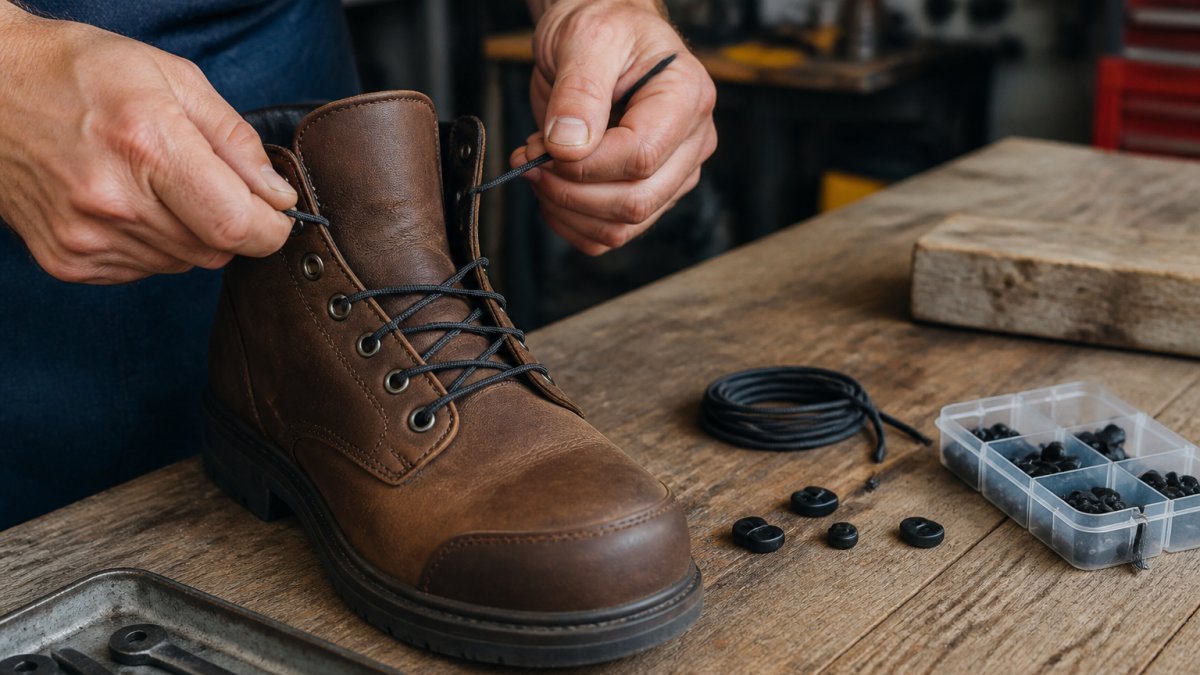
What You'll Need:
- One set of no-tie laces (uLace Classic or ProFormance)
- Your work boots
- 5 minutes of patience
Step 1: Remove the Old Laces [Time: 1 minute]
Pull the existing laces out completely. Check each eyelet for burrs or sharp edges that could fray elastic.

Step 2: Thread the First Lace End [Time: 2 minutes]
Push the lace through the bottom eyelet from the inside out. uLace uses a simple push-and-pull method, no knotting required.
Step 3: Work Up the Eyelets [Time: 5 minutes]
Thread through each eyelet in a criss-cross pattern. Keep tension even. Don't pull tight at this stage.
Step 4: Adjust Tension [Time: 3 minutes]
Slip your foot in. Adjust the lace at each eyelet until the fit feels snug but not restrictive. Foot swelling through a shift is normal, so leave a little give.
Step 5: Secure the Ends [Time: 2 minutes]
Tuck the lace ends into the boot or trim per instructions. No knots, no dangling ends.
Expected Result: A boot you can step into and out of without touching a lace, with even pressure across the top of your foot.
Tension Adjustment and Eyelet Compatibility
Eyelet compatibility comes down to size and spacing: standard metal work-boot eyelets accept most elastic laces up to 3mm thick, while small, tightly spaced eyelets need a thinner lace.
After installation, most stretch-style systems let you re-thread and re-tension at any eyelet, the advantage over a fixed knot. Dial in a snug fit for a heavy work day, loosen it for the drive home.
Slip-On Conversion for Work Shoes: What Changes on the Job
Slip-on conversion turns a lace-up shoe into an easy on-easy off shoe using elastic laces. The change is small on paper and large in practice.
One user who made the switch on daily footwear reported saving several minutes of time daily and improved overall convenience, per a Dull Men's Club discussion.
For workers with limited mobility, the impact goes further. A user featured by 99% Invisible reconfigured standard shoes with no-tie adaptations to allow for one-handed operation, successfully managing their own footwear independently.
What changes on the job:
- No bending to retie mid-shift
- No dangling lace ends catching on equipment
- No pressure points from an overtightened knot
Workplace Safety, Durability, and Long-Term Material Fatigue
Safety is the angle most no-tie lace guides skip, but the workplace rules governing footwear are specific and enforceable.
What OSHA and ASTM Actually Say About Work Footwear
OSHA requires employers to ensure protective footwear wherever foot injuries from falling or rolling objects, sole-piercing objects, or electrical hazards are possible.
uLace ProFormance - Performance No-tie Laces - Black →
The takeaway: OSHA and ASTM govern the boot, not the lace. A no-tie system doesn't void a boot's ASTM rating as long as its protective features, steel or composite toe, puncture-resistant plate, metatarsal guard, remain intact and the boot stays secured.
A few workplace categories where this matters most:
- General industry and warehousing: OSHA 1910.136 footwear requirements apply wherever falling or rolling objects are a hazard.
- Construction: OSHA 1926.96 requires protective footwear meeting ASTM F2413 in areas where foot hazards exist.
- Electrical work: ASTM F2413 EH-rated footwear is common; a loose boot can shift the foot inside the shoe and reduce the intended insulation coverage.
None of this requires a knot. It requires consistent tension, which is exactly what a properly installed elastic lace provides.
Why Knots Fail and Elastic Doesn't
The UC Berkeley study on shoelace mechanics showed that impact and leg swing combine to undo knots, which is why "double-knotting" only delays the problem. On a ladder, a loading dock, or a factory floor, an untied lace is a genuine hazard, a trip point and a snag point. Elastic laces eliminate that failure mode because there is no knot to work loose.
Long-Term Material Fatigue: Silicone vs. Bungee
Durability is the trade-off to watch, and the two dominant materials age differently.
Elastic (bungee-style) laces, the category uLace builds, rely on a woven or braided core wrapped in a stretch sheath. Under a daily 8-12 hour shift, the elastic core fatigues first. Signs appear in this order:
- The lace stops snapping back to its resting length after you step in.
- Fraying shows at the eyelet contact points, where the lace rubs metal or plastic edges thousands of times.
- Tension becomes uneven, snug at the bottom eyelets, slack at the top.
Higher fiber counts (some heavy-duty laces use up to 25 strands, per RJ-Sport's industrial lace listing) extend the fatigue window because load is distributed across more strands.
Silicone laces resist moisture, sweat, and UV better and won't absorb odor, but offer less stretch and feel stiffer against the instep.
A Simple Inspection Schedule
- Weekly: Tug each lace section; confirm it returns to resting length.
- Monthly: Check eyelet contact points for fraying.
- Quarterly: Re-tension the lace across all eyelets; replace at the first sign of stretch loss, not after a lace fails on the job.
Ergonomic Benefits and Maintenance for Daily Work Wear
Ergonomics is where no-tie laces quietly outperform. Traditional laces create a single high-pressure point at the knot; elastic systems distribute tension evenly across the whole lacing system. Why that matters depends on the foot condition.
How Consistent Tension Helps Specific Foot Conditions
Edema and shift-related swelling. Feet swell through long shifts, especially on concrete.
Plantar fasciitis and arch support needs. Footwear fit affects how the foot loads.
Diabetic foot concerns. For workers with diabetes, pressure points and friction are the enemy, how minor irritation becomes a wound.
Post-surgical and limited-mobility recovery. A user featured by 99% Invisible reconfigured standard shoes with no-tie adaptations to allow for one-handed operation, successfully managing their own footwear independently.
Our customer feedback echoes this. One uLace customer wrote: "I'm 72 and it's hard for me to bend over all the time to tie my shoelaces.
Cleaning and Maintaining a No-Tie Lace System
A no-tie lace system is a small mechanical assembly, and it lasts longer if you treat it that way.
Routine cleaning. Wipe laces with a damp cloth monthly.
Cleaning around hardware. On a cord-lock system, the plastic cinch collects grime.
Replacing individual components instead of the whole system. This is where no-tie laces beat traditional laces outright.
When to replace rather than clean. Replace the lace when it stops returning to resting length.
Conclusion: Choosing the Right No Tie Laces for Your Work Shoes
Picking the right no tie laces for work shoes comes down to three questions: how many eyelets, how heavy the boot, and how much you bend. Answer those and the choice is obvious.
At uLace, we've made no-tie laces since 2009 and back every order with the uLace Guarantee.
Buy the work shoes you love. Let uLace turn them into hassle-free slip-ons.
Frequently Asked Questions
Do no tie shoelaces work for heavy-duty work boots?
Yes, when you choose the right specification. Look for a secure stretch design that holds tension through walking, climbing, and lifting. Thin fashion laces will not hold up, so match the lace to the boot's weight and eyelet count.
Are elastic laces safe for construction or warehouse jobs?
Elastic laces can be safe for physically demanding jobs when installed correctly. The main risks are loose lace ends and loss of tension. Choose a system with a low-profile lock or a stretch design that stays snug, and check tension at the start of each shift. No-tie laces remove dangling loops that can catch on equipment, which reduces trip and snag hazards compared to untied traditional laces. Always follow your employer's footwear policy.
How do you install no-tie laces on work shoes?
Installation takes a few minutes per shoe. Thread the elastic lace through the eyelets using the pattern that matches your shoe type, then secure the ends with the included anchors or lock. For uLace, the process is a simple push and pull method with no tools required. Adjust tension by pulling more or less lace through the top eyelets until the fit feels snug but not tight. Test by slipping the shoe on and off a few times before a full shift.
Can no-tie laces help with foot fatigue during long shifts?
They can help indirectly. Elastic laces provide consistent tension that adapts as your feet swell during a long shift, which reduces pressure points compared to laces tied once and left tight all day. A snug, even fit supports the arch and midfoot better than a loosening knot. Workers who stand or walk for 8 to 12 hours often notice less discomfort when the lace tension stays constant. Pair them with proper insoles for the best result.
What is the difference between lock-style and stretch-style no-tie laces?
Lock-style systems use a plastic cinch or toggle to hold tension, so you adjust once and the lock keeps the fit. Stretch-style laces rely on the elasticity of the cord itself, often with a bungee-like core, to stay snug without a lock. Lock-style gives more precise tension control but adds hardware that some users find bulky. Stretch-style is lighter and lower profile but may need re-adjustment over time. Both work for work shoes if the materials are heavy-duty.