




Elastic Laces for Work Boots: Are They Worth It in 2026?
Last Updated: November 9, 2026
Quick Summary
Elastic laces for work boots are worth it if your job involves constant on-and-off transitions, foot swelling across a shift, or if bending to tie laces is painful or slow. They are a poor fit if your workplace demands a locked-down, fully adjustable fit for heavy loads or uneven terrain.
- Elastic laces hold steady pressure across the instep and turn a lace-up boot into a slip-on in seconds.
- Keep lower eyelets snug and leave slight give at the top two eyelets for ankle support.
- Budget one set of elastic laces per year of daily wear and inspect them monthly.
- A set of uLace ProFormance runs $14.99 and comes in five colors.
- Skip elastic laces if you climb, carry heavy loads, or need to retune tension constantly.
Table of Contents
- The Short Answer: When Elastic Laces Make Sense on Work Boots
- How Elastic Laces Work and Where They Differ From Regular Laces
- Fit, Tightness, and Ankle Support During a Full Work Shift
- How to Lace Work Boots for Ankle Support With Elastic Laces
- The Best No-Tie Laces for Boots: What to Look For
- Pros and Cons of Slip-On Work Boots and No-Tie Setups
- Durability, Maintenance, and Total Cost Over a Year
- Upgrade Your Work Boots With uLace ProFormance
- Frequently Asked Questions
The Short Answer: When Elastic Laces Make Sense on Work Boots
Elastic laces for work boots are worth it if your job involves constant on-and-off transitions, if you deal with foot swelling across a shift, or if bending to tie laces is painful or slow. They are a poor fit if your workplace demands a locked-down, fully adjustable fit for heavy loads or uneven terrain.
That is a warning about fit, not a verdict against elastic lacing. A loose boot is a painful boot, whatever holds it closed.
At uLace, we have been making no-tie laces since 2009, so we have a stake in this answer. We will still tell you where elastic laces lose.
Below, we break down fit, safety, durability, and cost so you can decide in about five minutes.
How Elastic Laces Work and Where They Differ From Regular Laces
Elastic laces are stretchable cords that hold tension through the eyelets without a knot, letting you slip a boot on and off while keeping steady pressure across the instep. Regular laces lock a fixed tension you set by hand each time.
The practical difference shows up in three places:
- Tension: conventional laces hold one setting until you retie. Elastic laces stretch as your foot swells and settle back.
- Speed: no-tie laces turn a lace-up boot into a slip-on in seconds.
- Pressure: elastic spreads load more evenly, which eases lace pressure and pressure points.
For a closer look at the trade-offs, our comparison of elastic laces vs regular laces covers fit, security, and convenience side by side.
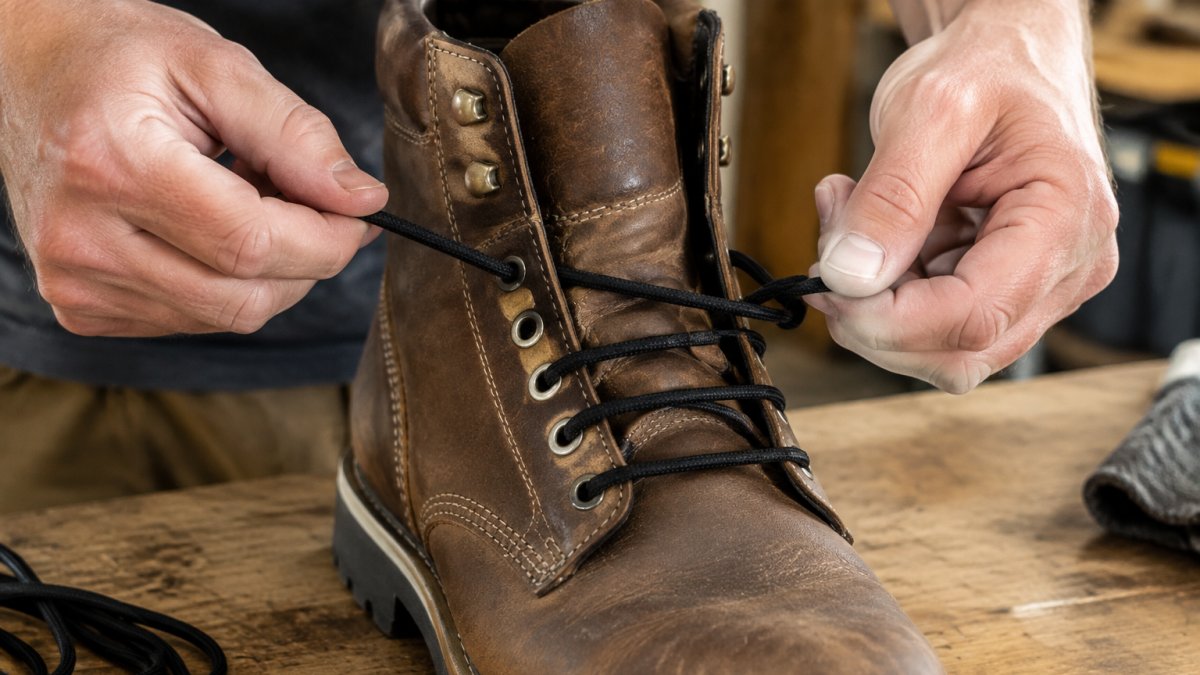
Fit, Tightness, and Ankle Support During a Full Work Shift
Elastic laces can hold a snug fit all shift, but they cannot create ankle support a boot was not built to give. Support comes from the boot's collar height, shank, and upper stiffness. The lace only controls how firmly your foot sits inside that structure.
That is where a full-shift view matters. Over a long standing or walking shift, feet can spread and lengthen slightly as they warm and load, and the heel can lift inside the boot if the midfoot loosens. A conventional lace holds one tension through all three changes.
Break the shift into three phases to judge fit:
- First hour: the boot should feel snug across the midfoot with no heel lift. If the heel slides now, it will slide worse later. Elastic laces cannot fix a boot that is too wide or too long in the heel.
- Mid-shift: this is where swelling shows. A fixed lace either digs across the instep or, if tied loose, lets the foot move. Elastic laces absorb the change, which is why workers who stand all day often report fewer hot spots by hour six to eight.
- Late shift: fatigue changes how you walk. A boot that has loosened lets the ankle roll more on uneven ground.
Ankle stability is the trade-off to be honest about. A tall, stiff work boot with a firm collar gives lateral support; the lace only keeps the foot seated in that collar.
Heel hold deserves its own check. With the boot on and the laces set, try to lift your heel inside the boot. A little movement is normal; a distinct slide means the midfoot is not snug enough. Reroute the lace across the midfoot eyelets or add a locking pattern before you blame the laces.
One caveat: elastic laces are not a full replacement for adaptive footwear in every situation. A New York Times Wirecutter review of elastic shoelaces notes they still require some interaction and cannot cover every accessibility need.
How to Lace Work Boots for Ankle Support With Elastic Laces
Lace work boots for ankle support by keeping the lower eyelets snug and leaving slight give at the top two eyelets, so the collar flexes without slipping. That balance is what makes a secure fit last a full shift.
Follow this sequence:
- Thread from the bottom eyelets upward, keeping even tension on both sides.
- Pull firm across the midfoot, where most support is generated.
- Leave a little slack at the top eyelets so the ankle flexes when you crouch.
- Trim and secure the ends so nothing drags.
Loose, dragging laces are a genuine trip hazard on a job site. That alone is a reason to get the install right.
Our step-by-step installation guide walks through threading, trimming, and securing in under five minutes.
The Best No-Tie Laces for Boots: What to Look For
The best no-tie laces for boots combine firm stretch, a low-profile profile that clears the eyelets, and ends that stay put. Stretch that is too soft lets the boot feel sloppy; too stiff and you fight the boot on every wear. Even a well-chosen stretch can’t compensate for leather that still resists movement, so Lazy B Western Wear & Tack is a natural next stop when deciding how to make stiff boots more comfortable.
Check these four things before you buy:
- Elasticity: enough stretch to slip on, enough rebound to stay tight.
- Diameter: thin enough to pass through boot eyelets cleanly.
- End security: no loose laces to catch on equipment or drag.
- Color and length: match the boot and the eyelet count.
For hiking and heavy boots, our secure-fit guide for no-tie laces on hiking boots covers the same tightness and durability questions.
Pros and Cons of Slip-On Work Boots and No-Tie Setups
The pros and cons of slip-on work boots come down to speed and comfort versus maximum adjustability. Elastic laces win on convenience; conventional laces win on fine-tuning tension.
| Factor | Elastic Laces | Conventional Laces |
|---|---|---|
| On and off speed | Seconds, no bending | Slower, requires retying |
| Tension adjustment | Fixed stretch, set once | Fully adjustable per wear |
| Foot swelling | Absorbs change | Needs retying mid-shift |
| Loose lace risk | Low when installed right | Higher if knots fail |
| Best for | Repetitive transitions, swelling, mobility limits | Heavy loads, uneven terrain |
A boot forum commenter noted elastic laces worked on many shoes but were not great on hiking and work boots, and a bootmaker's comparison describes lace-ups as offering a customizable fit. Neither source offers controlled evidence, but the point stands: if you need to crank tension for a heavy carry, traditional lacing gives you more room to do it.
Best for: warehouse, retail, and light-duty workers who are in and out of boots all day. Skip if: you climb, carry heavy loads, or need to retune tension constantly.
Durability, Maintenance, and Total Cost Over a Year
Elastic laces typically outlast the laces they replace in convenience, but they are not permanent, and a year of daily wear is a fair planning horizon. Stretch relaxes over time, and that is when you replace them. The details that matter are what causes the loss, how to slow it, and what a year actually costs.
Three things wear an elastic lace:
- Stretch loss: the cord relaxes with repeated loading. You will notice it as a boot that goes on easily but feels loose by mid-shift, or a lace that no longer snaps back when you pull it.
- Fraying at the ends and eyelets: grit trapped in metal eyelets acts like sandpaper. Frayed ends are also a snag risk around equipment.
- Contamination: mud, oil, and concrete dust pack into the weave and stiffen the cord, which changes how it stretches.
Maintenance is simple but worth doing on a schedule. Rinse off grit with plain water, let the laces air-dry fully before the next shift, and check the ends and the eyelet contact points for fraying. A soft brush clears packed dust from the weave. Do not machine-dry elastic laces; heat is what kills the rebound.
Watch out: skipping the rinse is the most common way workers shorten lace life, because grit stays in the eyelets and grinds the cord every time the boot flexes.
Replacement triggers are easier to judge than a calendar:
- The lace no longer recovers its length after you stretch it.
- You are retightening mid-shift when you did not used to.
- Fraying reaches the eyelet contact area, not just the tip.
- The boot feels sloppy on terrain where it used to feel secure.
On cost, a set of uLace ProFormance runs $14.99. Compare that with repeatedly replacing conventional laces that fray, snap, or get caked in mud. A worker who goes through several sets of conventional laces a year, common in muddy, dusty, or oily jobs, will usually spend more on replacements than on one set of elastic laces, before counting the time spent retying.
A practical year-long view: budget one set of elastic laces per year of daily wear, inspect monthly, and replace at the first sign of lost rebound rather than waiting for a failure. That keeps the fit consistent and avoids the mid-shift looseness that sends workers back to conventional laces.
For how long a set realistically lasts, our guide on how long elastic shoelaces last breaks down the wear cycle.
Upgrade Your Work Boots With uLace ProFormance
uLace ProFormance is our no-tie lace built for people who want slip-on speed without giving up a secure, stretchy fit. We created the no-tie elastic shoelace category in 2009, and ProFormance is the version we point workers toward.
It installs with a simple push-and-pull method. The laces keep boots looking neat and tidy and prevent dangling, dirty shoestrings. Colors include Black, White, Royal Blue, Scarlet Red, and Neon Orange, all at $14.99.
One customer, 72, shared that bending to tie laces was hard, and now she just slips her foot through her shoes.
You can shop uLace ProFormance no-tie laces and pick the color that matches your boots.

The real question is not whether elastic laces are convenient. It is whether your boots will still feel secure at hour ten. If you want slip-on speed with steady tension, uLace ProFormance delivers it: easy push-and-pull installation, a stretchy fit that lasts all day, and colors that keep work boots looking sharp. Get started with uLace and turn your lace-up boots into hassle-free slip-ons.
Frequently Asked Questions
Do elastic laces provide enough support for heavy-duty work boots?
It depends on the boot and the job. Anyone who needs firm ankle stability should test a pair on a short shift first. For standing and walking roles, most workers find the fit adequate.
Are no-tie laces safe for construction or industrial work environments?
The main safety concern is loose laces. Elastic laces that are trimmed and tucked correctly remove the dangling loop that catches on equipment or creates a trip hazard. Check your employer's footwear policy before switching, since some sites require specific boot closures.
Can you use elastic laces on steel-toe boots?
Yes, as long as the laces fit the eyelet count and boot height. Steel-toe boots usually have six to eight eyelet pairs, and elastic laces thread through the same eyelets as regular laces. The toe cap does not affect the lacing. What matters is matching lace length to the boot and checking that the elastic tension still holds the upper snug over the instep, since a loose fit around a heavy toe box can let the foot slide forward.
Do elastic laces last as long as standard nylon laces?
At $14.99 for a set of uLace ProFormance laces, that is a modest annual cost compared with the time saved on tying and untying each shift.
How do elastic laces affect the fit and stability of work boots?
For a secure fit on uneven ground, pair them with a boot that already has good heel hold.
