




Shoelaces for Easier Dressing: No-Tie Laces Guide
Table of Contents
- Why Shoelaces for Easier Dressing Change Your Morning
- No Tie Shoelaces for Kids: Independence From the First Pair
- Elastic Shoelaces for Seniors: Less Bending, More Comfort
- How to Install Elastic Laces: A Step-by-Step Walkthrough
- Comparing uLace Options: Kiddos, Shorts, Classic, and ProFormance
- Silicone vs. Fabric Laces: Which Stretchable Material Lasts?
- Pairing Shoelaces for Easier Dressing With Other Adaptive Tools
- Conclusion
- Frequently Asked Questions
Last Updated: September 14, 2026
Why Shoelaces for Easier Dressing Change Your Morning
Bending to tie a lace takes seconds for some and several painful minutes for others. That gap is why shoelaces for easier dressing have moved from niche medical catalogs into mainstream footwear: elastic, no-tie laces replace the knot entirely, so you thread them once, set your tension, and never tie again.
At uLace, we've made that product since 2009, and customer feedback rarely changes: the first complaint is bending, the second dexterity, the third time.
The CDC's disability and mobility data shows that mobility limitations affect a substantial share of adults, and difficulty with fine motor tasks like tying is one of the most common daily-living complaints reported to occupational therapists. A single pair of adaptive laces costs less than a coffee and removes that task permanently.
Elastic shoelaces are stretchable laces that replace standard ties with a fixed, pre-tensioned fit, letting you slide a shoe on and off without untying anything. The lace doesn't hold the shoe shut through knot friction, it holds it shut through stretch.
No Tie Shoelaces for Kids: Independence From the First Pair
The best no tie shoelaces for kids do one job: let a child put on their own shoes without an adult kneeling down. Preschool teachers and occupational therapists recommend them because the child controls the fit.
The mechanics are simple: a child steps in, the lace stretches over the instep, and the shoe stays put, no bow to retie at recess, no lace dragging through mud.
Picking the Right Size for Small Feet
Kids' shoes have fewer eyelet rows than adult shoes, usually four to six pairs, so a shorter lace works and an overly long one bunches at the tongue. uLace Kiddos sets are built for this range and start at $5.99.

A practical rule: count the eyelet pairs, then match the lace set to that count rather than shoe size. A child's shoe size can change twice a year; the eyelet count usually doesn't.
Elastic Shoelaces for Seniors: Less Bending, More Comfort
Elastic shoelaces for seniors solve a problem regular laces create: every wear requires a full bend and a two-handed knot, the hardest part of getting dressed for anyone with arthritis, back pain, or balance concerns.
One uLace customer put it plainly: "I'm 72 and it's hard for me to bend over all the time to tie my shoelaces. Now I just slip my foot through my shoes and that's it."
The shoe goes on standing up, at the door, without a chair.
Arthritis-Friendly and Dexterity-Friendly Fit
Grip strength is the hidden variable: tying a bow requires pinching a thin cord, looping it, and pulling it tight with the fingertips. Arthritis and neuropathy make that sequence unreliable, so many people stop tying and force their feet into pre-tied shoes, damaging the heel counter over time (the CDC).
Slip-on conversion avoids the damage. The lace stays threaded and tensioned; the foot does the work.
How to Install Elastic Laces: A Step-by-Step Walkthrough
Installation takes about five minutes per shoe and requires no tools: feed the lace through each eyelet, set your tension at the top, and lock it in place.
Total Time: 10 minutes for a pair Difficulty: Beginner
What You'll Need
- One set of elastic laces sized to your eyelet count
- The shoes you plan to convert
- A few minutes at a table or counter
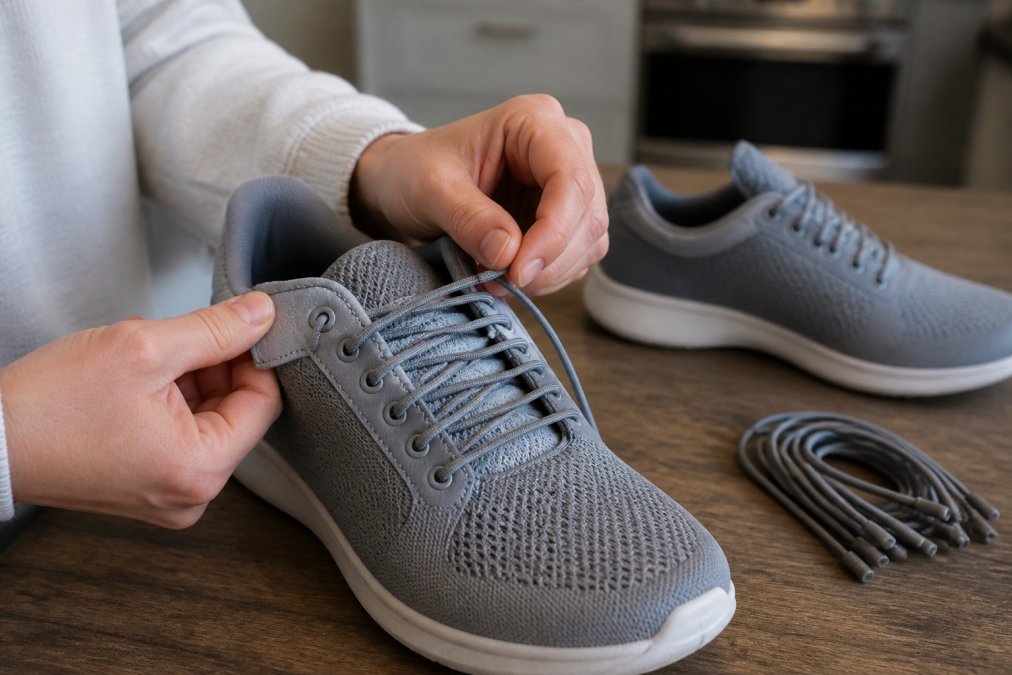
Step 1: Remove the old laces. Pull the standard laces out completely, including any tucked under the tongue.
Step 2: Thread from the bottom. Start at the lowest eyelet pair and work upward, alternating sides so the lace crosses evenly.
Step 3: Set tension at the top. Pull the final segment until the shoe feels snug but still slides on without a fight. Too tight strains the eyelets; too loose and the heel slips.
Step 4: Lock the ends. Secure the lace ends using the method included with your set.
Step 5: Test the slip-on. Put the shoe on standing up. If you need a finger to pull the heel, the tension is slightly too tight.
Expected Result: A shoe that goes on and off without untying and stays secure during normal walking.
Troubleshooting Tricky Eyelet Types
Most installation problems trace back to eyelet geometry, not the lace.
- Small or narrow eyelets: Feed the lace end at an angle and twist slightly as you push.
- Metal grommets with sharp edges: Check for burrs before threading.
- Fabric loop eyelets (no metal): These stretch with the lace, so set tension slightly looser than with grommets.
- Hidden or offset eyelets: Thread one row at a time and check tongue alignment before moving up.
- Boots with hooks: Skip the hooks if possible. Elastic laces work best on standard eyelets.
Comparing uLace Options: Kiddos, Shorts, Classic, and ProFormance
Four uLace lines cover nearly every use case; the differences come down to lace length, stretch profile, and how much of the lace shows.
| Style | Price | Best For | Lace Length |
|---|---|---|---|
| Kiddos | $5.99 | Kids' sneakers, 4-6 eyelet pairs | Short |
| Classic | $6.49 | Adult sneakers, standard eyelet count | Standard |
| Shorts | $12.99 | Low-profile, minimal-look conversions | Short segments |
| ProFormance | $14.99 | Running and athletic use | Standard, higher tension |
Kiddos is the entry point for families. Available in Medium Grey, Blue Teal, Black, White, and Canvas, it's built for small shoes with fewer eyelets. The price makes it easy to convert several pairs at once.

Classic is the workhorse for adult sneakers. Black at $6.49 covers most standard lace-ups, and the length suits a typical six-to-seven eyelet row.
Shorts takes a different approach: short segments instead of one continuous lace, creating a clean, low-profile look for anyone who wants the conversion to look intentional. Peachy Orange, Plum Purple, and Black are the current options at $12.99.
ProFormance is the athletic line at $14.99, built with a firmer stretch so the shoe holds during running and lateral movement.
Silicone vs. Fabric Laces: Which Stretchable Material Lasts?
Most guides stop at "fabric is comfy, silicone is waterproof." The question that decides which lace you buy is how each material behaves over months of daily stretch cycles, and how it fails.
How Each Material Fails
Tension Loss Over Time: What to Expect
Medical-Grade vs. Casual-Use Laces
Matching Material to Shoe and Use
Pairing Shoelaces for Easier Dressing With Other Adaptive Tools
Elastic laces solve one problem, the tie. They don't solve bending, reaching, or balance. The people who get the most out of them treat footwear as one part of a small system, not a single purchase, and that system is where the real independence gains live.
The Four Friction Points in Getting Shoes On
Break the task down and you'll see where each tool fits:
- Reaching the feet. No lace helps until you can get the shoe within reach.
- Seating the heel. Even a slip-on needs the heel to drop in, the step that trips up most people.
- Closing the shoe. The only step elastic laces replace.
- Balance during the process. A stable position matters more than any single tool.
Match your tool to the step that's actually failing you. Buying a lace when your problem is reaching is a common and expensive mistake.
Tools That Pair With No-Tie Laces
- Long-handled shoe horn (24-31 inches): Seats the heel without bending, the most complementary tool to a slip-on conversion, because it removes the last bend in the sequence.
- Sock aid: A plastic gutter with cords that pulls a sock on without reaching your foot. Pairs naturally with slip-on shoes, since both assume seated dressing.
- Dressing stick: A long rod with a hook and push end for pulling a shoe toward you, adjusting a tongue, or retrieving a dropped item.
- Reacher/grabber: Extends reach for shoes stored low or pushed under a bed.
- Seated dressing station: A stable chair with arms near where you keep your shoes (the CDC). Not a product so much as a setup, and it removes the balance risk that causes most falls during dressing.
Medical-Grade vs. Casual-Use: Which Tier You Actually Need
Building the System Around Your Specific Limitation
The combination matters more than any single item, and the right combination depends on which friction point is yours:
- Can't bend, full hand strength: Long-handled shoe horn plus elastic laces. You can still pull and adjust; you just can't reach the floor.
- Arthritis or neuropathy in the hands: Elastic laces are the priority. Add a dressing stick if reaching is also limited.
- Balance concerns: Seated dressing station first, then laces. The fall risk during dressing is the thing to eliminate before anything else.
- Low vision or one-handed use: Laces with high-contrast colors and a firm end-lock, plus a reacher for retrieval.
Where the Shoe Itself Fits
Adaptive laces work on almost any standard lace-up sneaker, but the shoe still matters: look for a firm heel counter (so the slip-on doesn't collapse), a wide opening, and a slip-resistant outsole. A flimsy heel counter loses its shape quickly once you're stepping in and out daily, no matter how good the lace is.
Conclusion
Getting dressed shouldn't require a strategy session, yet for millions with limited mobility, dexterity challenges, or a house full of kids running late, it does. The fix is small and cheap: swap the laces once, and the shoe becomes something you step into.
uLace has been making elastic, no-tie laces since 2009, with styles for kids, adults, and athletes starting at $5.99. Every set installs in minutes with a simple push-and-pull method, ships fast from the USA, and comes with the uLace Guarantee. Buy the sneakers you love, and let uLace turn them into hassle-free slip-ons.
Take the quiz to find your size and style.
Frequently Asked Questions
How do no-tie shoelaces work for daily wear?
No-tie laces replace standard strings with stretchable material that flexes as your foot slides in and out. Each segment stays under gentle tension, so the shoe holds its shape without a knot. uLace uses a simple push-and-pull installation, and the lace ends tuck away out of sight. That means no bow to retie, no dangling ends to trip on, and no loosening mid-day.
Are elastic shoelaces good for children with mobility needs or fine motor challenges?
Yes. Kids who struggle with fine motor tasks or who need extra time to dress benefit most because there is nothing to tie. uLace Kiddos are sized for smaller shoes and priced at $5.99, and they let a child pull a shoe on and go. Parents of children with autism and other developmental needs often choose them to reduce morning friction and build independent dressing skills.
What are the best no-tie shoelaces for seniors who have trouble bending over?
Look for stretchable laces that hold tension without needing adjustment. uLace Classic ($6.49) and uLace Shorts ($12.99) both convert lace-up sneakers into slip-ons, so there is no bending, no knot to reach, and no lace to retie. A long-handled shoe horn pairs well with them for anyone who also has trouble reaching their feet. Customers in their 70s report that slipping shoes on and off is now effortless.
How long do elastic shoelaces last before they stretch out?
Durability depends on how often the shoe is worn. Fabric-based stretch laces like uLace Classic and Shorts hold tension through repeated on-and-off cycles. Rotating between two pairs of shoes or replacing laces once a year keeps the fit secure, especially for kids who wear the same sneakers daily.