




7 Adaptive Lacing Techniques for Physical Therapy Success
Last Updated: October 24, 2026
Quick Summary
Adaptive lacing techniques are customized shoe-lacing patterns that transform independence for individuals with mobility challenges, arthritis, or injury recovery by matching specific physical barriers like limited hand strength, reduced reach, or fine motor coordination difficulties to targeted lacing methods.
- The one-loop method reduces hand coordination demands by creating a single loop instead of two, making it effective for moderate fine motor challenges.
- Elastic no-tie shoelaces eliminate bending, gripping, and fine motor demands entirely by converting any lace-up shoe into a slip-on.
- Window lacing redistributes pressure across the midfoot and arch by skipping eyelets in the middle section, benefiting people with high insteps or foot swelling.
- Graded practice plans progress through five phases from observation to generalization, with backward chaining ensuring early success and preventing frustration.
- Thicker lace material, two-color laces, and lever-based tools reduce the hand strength required for traditional tying techniques.
Table of Contents
- Why Adaptive Lacing Techniques Matter in Physical Therapy
- Assessment: Identifying Your Lacing Needs
- The One-Loop Method for Quick Independence
- Adaptive Shoe Tying Techniques for Limited Hand Strength
- Shoe Lacing Techniques for Limited Mobility and Reach
- Window Lacing Technique for High Insteps and Arch Support
- Elastic No-Tie Shoelaces as an Adaptive Solution
- Building Your Graded Practice Plan
- Coaching Caregivers and Clinicians Through Lacing Transitions
- Frequently Asked Questions
Why Adaptive Lacing Techniques Matter in Physical Therapy
Adaptive lacing techniques transform shoe independence from an impossible task into an achievable goal. Research examining how different shoe-lacing patterns influence foot biomechanics has shown that customized lacing approaches may optimize comfort and reduce injury risk associated with abnormal pressure distribution PubMed research on lacing patterns.
At uLace, we understand that independence matters. Whether you're a physical therapist designing a patient's recovery plan, a caregiver supporting a loved one, or an individual working toward greater self-sufficiency, adaptive lacing techniques create real progress.
This guide walks you through approaches to lacing that match different physical abilities and therapy objectives. You'll learn when to use each technique, how to teach it effectively, and how to build a graded practice plan that measures real gains.
Assessment: Identifying Your Lacing Needs
Before selecting an adaptive lacing technique, identify the specific barrier your patient or client faces. Is the challenge fine motor coordination? Limited reach or bending ability? Reduced hand strength? Pain with gripping?
Start by observing attempts at standard lacing. Watch for:
- Hand coordination issues: Fingers struggle to cross laces, form loops, or pull tension evenly
- Reach limitations: Bending to access shoe eyelets causes pain or is physically impossible
- Strength deficits: Gripping and pulling laces requires excessive effort or causes fatigue
- Sensory needs: Tactile feedback or visual cues help with task sequencing
- Stability concerns: Loose or poorly secured laces create fall risk
Consider also the person's footwear preferences. Some individuals have favorite sneakers they want to keep wearing. Others need shoes that fit specific orthotic devices or accommodate swelling. Understanding these constraints shapes which adaptive lacing technique will actually get used consistently.
guidance on choosing accessible footwear for disabled adults provides additional context for matching shoe selection to mobility needs. You may also want to review easy ways to tie shoes for alternative methods that complement the adaptive techniques .
The One-Loop Method for Quick Independence
The one-loop method simplifies traditional lacing into a single, repeatable motion. Instead of forming two loops and crossing them, you create one stable loop and pull the working lace around it. This reduces hand coordination demands and works well for individuals with moderate fine motor challenges or mild strength limitations.
How to teach the one-loop method:
- Start with the laces already threaded through eyelets and pulled snug (backward chaining, the learner finishes the task, not starts it)
- Create one loop by pinching the lace and pulling it upward to form a circle
- Wrap the other lace end around the loop base
- Pull the wrapped end through the opening to tighten
- Adjust tension as needed
This method takes fewer steps than traditional tying and reduces the cognitive load of tracking two separate loops.
The one-loop technique works best for individuals who have adequate hand strength but struggle with bilateral coordination or sequencing. It's less effective for people with severe grip weakness or limited reach, since it still requires pulling tension through lace material.
Adaptive Shoe Tying Techniques for Limited Hand Strength
When arthritis, weakness, or reduced dexterity makes gripping difficult, traditional lacing becomes exhausting. Adaptive techniques for limited hand strength focus on reducing the force needed and distributing effort across larger muscle groups.
Key strategies:
- Thicker lace material: Easier to grip than standard thin laces
- Pre-loosened laces: Reduce the pulling force required to tighten
- Two-color laces: Visual markers help fingers track which lace to pull, reducing confusion and repeated attempts
- Lever-based tying: Use a small stick or pencil as a lever to help pull tension rather than relying on finger strength alone
For individuals with significant grip limitations, elastic no-tie shoelaces offer the most practical solution. These eliminate the need for gripping, pulling, or sustained finger tension entirely. With elastic laces, the shoe becomes a slip-on, and the individual simply slides their foot in and out. How to Replace Standard Laces with Elastic Alternatives provides step-by-step installation guidance.
uLace ProFormance laces, designed for active use, maintain secure tension throughout the day without requiring any hand strength to don or doff the shoe.
Shoe Lacing Techniques for Limited Mobility and Reach
Limited mobility, whether from spinal cord injury, stroke recovery, or joint restrictions, often means the person cannot bend down to reach their feet. Traditional lacing requires forward bending and sustained reach.
Practical adjustments:
- Seated lacing: Bring the foot up onto a stool or chair rather than bending forward; this reduces spinal flexion and keeps the shoe at waist height
- Elastic laces: Eliminate the need to reach the shoe at all; the person simply slides their foot in while seated
- Lacing aids: Long-handled shoe horns or lace-threading tools extend reach without requiring trunk flexion
- Shoe positioning: Place the shoe on a low table or ottoman at knee height rather than on the floor
For individuals with significant reach limitations, the most effective solution is often to eliminate lacing altogether. Elastic no-tie shoelaces transform any favorite sneaker into a slip-on shoe, removing the physical barrier entirely. This approach respects the person's footwear preferences while removing the mobility demand.
How to Choose Easy-On Shoes for Disabled Adults helps identify which shoe styles work best with adaptive lacing solutions and which individuals may benefit most from slip-on designs.
Window Lacing Technique for High Insteps and Arch Support
High insteps and rigid arches create lacing challenges: standard crisscross patterns place pressure directly on the arch, causing discomfort and reducing circulation.
How window lacing works:
- Lace the bottom eyelets (toe area) in a standard crisscross pattern
- At the midfoot, skip the next pair of eyelets entirely, creating an open "window"
- Resume crisscross lacing above the window through the upper eyelets
- Adjust tension: keep the toe section snug but the upper section looser
This pattern reduces direct pressure on the arch while maintaining ankle stability through the upper lacing. Individuals with high insteps or rigid arches often report immediate comfort improvement.
uLace ProFormance - Performance No-tie Laces - Black →
The window technique also works well for people with foot swelling or circulation concerns. The open midfoot section accommodates swelling throughout the day without requiring lace readjustment.
For added arch support, combine window lacing with elastic no-tie laces. The elastic provides gentle, consistent support across the arch area while the window pattern prevents concentrated pressure points.
Elastic No-Tie Shoelaces as an Adaptive Solution
Elastic no-tie shoelaces represent the most significant advancement in accessible footwear. By replacing traditional laces with stretchy, elastic material, any shoe becomes a slip-on.
Why elastic laces work across multiple challenges:
- Fine motor issues: No tying required
- Strength limitations: No pulling or gripping needed
- Mobility restrictions: No bending to access the shoe
- Cognitive challenges: No sequencing or memory demands
- Time pressure: Slip-on takes seconds versus minutes
uLace offers multiple elastic lace options designed for different shoe styles and activity levels. uLace ProFormance - Performance No-tie Laces provide secure tension for active use, sports, and frequent walking. uLace Classic laces work well for everyday wear and casual sneakers.

Elastic laces aren't just for individuals with disabilities. Parents managing morning routines with young children, busy professionals, seniors, and anyone who values convenience use elastic laces daily. The solution works for any lace-up shoe.
Installation steps:
- Remove standard laces completely
- Feed elastic lace through eyelets using the same crisscross or window pattern
- Tie a knot at each end to secure
- Adjust tension by pulling the elastic gently until the shoe fits snugly
- Slide foot in and out as needed
Once installed, elastic laces last for months with normal wear. They maintain consistent tension and don't loosen or come untied during activity.
Building Your Graded Practice Plan
Effective lacing instruction follows a graded progression: start with the easiest version of the task, add complexity gradually, and measure progress at each step.
Your graded practice framework:
| Practice Phase | Focus | Duration | Success Indicator |
|---|---|---|---|
| Phase 1: Observation | Watch demonstration; no hands-on attempt | 1-2 sessions | Learner can describe the steps |
| Phase 2: Hand-over-hand | Therapist guides hands through full motion | 3-5 sessions | Learner anticipates each step |
| Phase 3: Guided practice | Learner leads; therapist provides verbal cues | 5-8 sessions | Learner completes 80% without cues |
| Phase 4: Independent practice | Learner performs alone; therapist observes | 2-3 sessions | Learner completes task consistently |
| Phase 5: Generalization | Learner applies technique to different shoes | 2-3 sessions | Learner adapts approach to new footwear |
Start each session with backward chaining: pre-lace the shoe and have the learner complete only the final step.
Use visual supports throughout. Two-color laces help the learner track which strand to pull. A laminated step-by-step photo guide provides a reference the person can check independently.
Measure progress weekly. Track: number of steps completed independently, time required, quality of tension (even versus lumpy), consistency across multiple attempts.
Lacing Guide provides a comprehensive reference for various techniques to support your practice plan and help learners review between sessions.
Coaching Caregivers and Clinicians Through Lacing Transitions
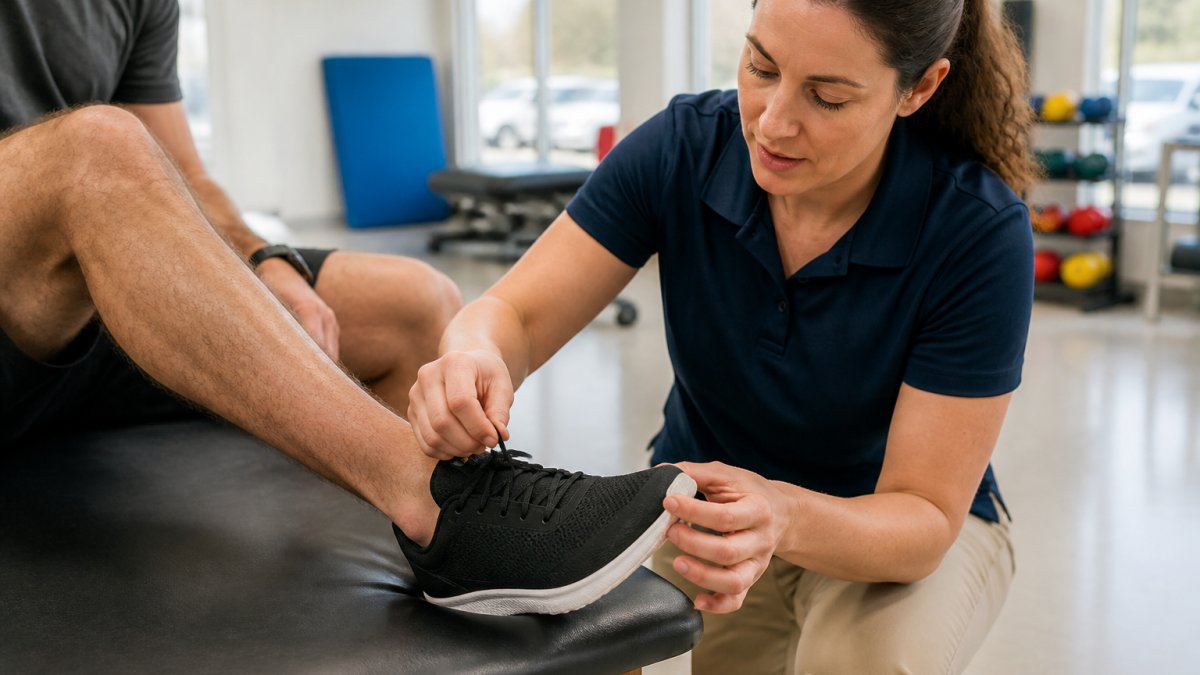
Teaching lacing isn't just about the learner, it's about building the caregiver's or clinician's confidence to guide the process effectively.
Key coaching principles:
- Resist the urge to take over: Doing the task faster isn't the goal; building independence is. Patience during practice pays off
- Use consistent language: Same words for each step each time (e.g., "pull the loop up" not "tighten it")
- Provide specific praise: "You pulled that loop evenly" beats "good job"
- Adjust the challenge, not the person: If progress stalls, simplify the task, not the learner's ability
- Plan for generalization: Practice with multiple shoe types and in different settings so the skill transfers
Clinicians should also educate caregivers about fall risk. Untied or poorly secured laces contribute to trips and falls, especially in individuals with balance challenges.
Document progress and share it with the care team. Occupational therapists, physical therapists, nurses, and family members all benefit from seeing measurable gains.
Building adaptive lacing skills takes time, but the payoff is genuine independence and dignity.
Frequently Asked Questions
What are adaptive lacing techniques and who benefits from them?
Adaptive lacing techniques are modified methods of tying, tensioning, and securing shoelaces to accommodate physical limitations, pain, or reduced mobility. They benefit people with arthritis, limited hand strength, reduced reach, high insteps, or those recovering from injury. Physical therapists often recommend these techniques as part of functional independence training.
Can different shoe lacing techniques reduce foot pain or pressure?
Yes. Customized lacing patterns can affect pressure distribution across the foot and reduce strain on tendons and joints. The window lacing technique, for example, reduces pressure on the top of the foot and is particularly helpful for high insteps or sensitive areas. One-loop and bunny-ear methods can reduce the fine motor demand, potentially lowering hand fatigue. The key is matching the technique to your specific foot structure and therapy goals.
Are elastic no-tie shoelaces a good alternative to traditional lacing?
Elastic no-tie shoelaces eliminate the need to bend, tie, or use fine motor skills, making them ideal for seniors, people with arthritis, or those with limited mobility. uLace elastic laces, for example, transform any sneaker into a slip-on while maintaining a secure, comfortable fit. They're particularly useful when traditional lacing is painful or impossible, though they work best with shoes that have adequate eyelets for proper tension distribution. Many physical therapists recommend them as a practical adaptation alongside other techniques.
How do I know which adaptive lacing technique is right for my needs?
Start with an assessment of your specific limitations: Can you bend? Do you have hand strength and dexterity? Is there pain in a particular area of your foot? A physical therapist can evaluate your foot structure, pressure distribution, and functional goals. For limited reach or bending, the one-loop or bunny-ear methods work well. For high insteps or arch pain, try the window lacing technique. For severe hand weakness or arthritis, elastic no-tie laces may be the best solution. Progress gradually and measure improvement in comfort, independence, and safety.
